You're about to commit serious money to a property, and the only evidence it'll work is a listing you liked and a hunch. A vacation rental business plan replaces that hunch with numbers you can check. Your first action today: write down the one thing that would kill the deal (a permit ban, a thin season, a mortgage you can't cover in a slow month) and make the plan test it first.
A lender, a partner, or your own spreadsheet will ask the same questions. Is it legal? Who books it? How much cash do you need before the first guest? What's left after every cost, in a bad year as well as a good one? The U.S. Small Business Administration's guide to writing a business plan describes two formats: a detailed traditional plan, which it suggests if you'll request financing from traditional sources, and a one-page lean plan. For a single rental, a short traditional plan built around the four questions below is usually enough.
What should a vacation rental business plan include?
An Airbnb business plan needs four parts: a legal and market check, an upfront cash budget, a 12-month revenue and expense forecast, and the return metrics that tell you whether the deal is worth doing.
Keep the executive summary to one paragraph at the top: the property, the market, the cash required, and the expected return in a base case and a downside case. Everything after it is evidence for that paragraph.
Legal and market check. Before any revenue number, confirm the rental is allowed where you're buying. Rules vary by city, building, and HOA, and they change. Record the permit requirement, any caps on nights or licences, tax registration, and anything in the building rules. Our Airbnb regulations guide walks through what to check. Then define your guest: who visits this area, when, and what they need (bedrooms, parking, a workspace, a quiet street).
Comparable listings. Pick a handful of listings with the same bedroom count, similar amenities, and a similar location. Record their nightly rates across seasons and how full their calendars look in each month. Treat this as an estimate, not a fact: a blocked night on a public calendar might be a booking or might be the owner.
How do you project revenue and expenses for a short-term rental?
Project revenue month by month from a realistic nightly rate and occupancy, then subtract every cost, including platform fees and a vacancy-heavy downside case, to see whether the property covers itself.
The core formula is simple:
Monthly room revenue = average nightly rate × nights in the month × occupancy rate
Add cleaning fees you charge guests as separate income, and list the cleaning you pay out as an expense. Work month by month instead of using one annual average, because seasonality decides whether you can pay the mortgage in February. If you need help with the occupancy side, see how to calculate your occupancy rate.
Platform fees belong in the plan as line items, and they differ by channel. Airbnb's service fee page says most hosts on the single-fee structure pay 15.5% of the booking subtotal, which covers the nightly price plus host fees such as cleaning, and that this structure is mandatory for hosts using property management software. Booking.com's commission explainer says its commission is a set percentage of the total booking amount that depends on country, property type, and your agreement, so you'll need your own contract figure. If you take direct bookings by card, Stripe's Ireland pricing page lists 1.5% + €0.25 for standard EEA cards. You can model channel differences with the Airbnb fee calculator and the OTA fee comparison.
A worked example you can copy
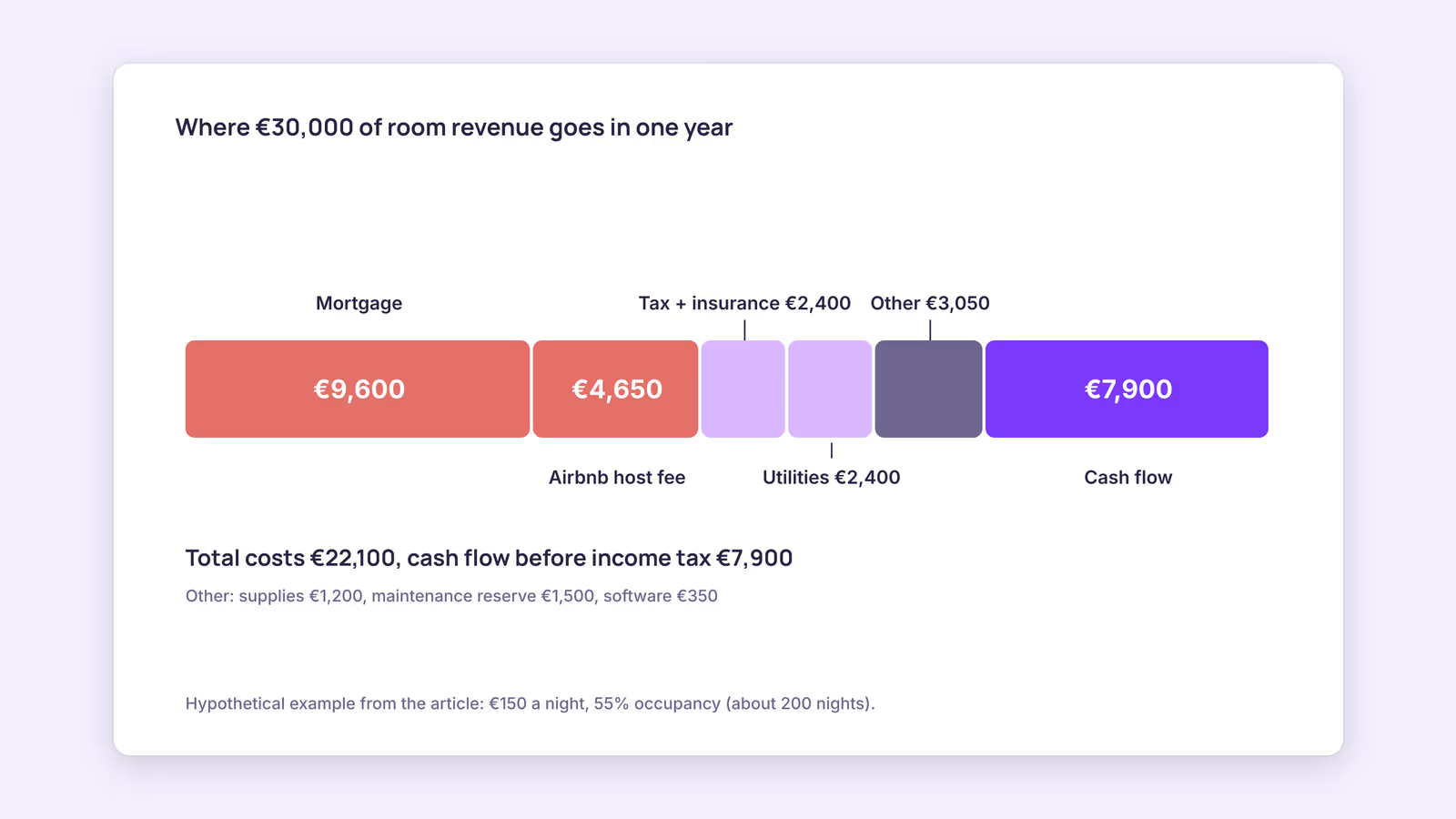
The figures below are a hypothetical two-bedroom unit, not a forecast for any real market. Replace every input with your own research.
| Line | Input | Annual amount |
|---|---|---|
| Nightly rate (average across the year) | €150 | |
| Occupancy | 55% (about 200 nights) | |
| Room revenue | €150 × 200 | €30,000 |
| Airbnb host fee | 15.5% of room revenue | €4,650 |
| Mortgage payments | hypothetical loan | €9,600 |
| Property tax and insurance | quotes from your insurer and municipality | €2,400 |
| Utilities and internet | last year's bills or provider quotes | €2,400 |
| Supplies and consumables | estimate per stay | €1,200 |
| Maintenance reserve | 5% of room revenue (our assumption) | €1,500 |
| Software | your chosen tools | €350 |
| Total costs | €22,100 | |
| Cash flow before income tax | €7,900 |
In this example, cleaning fees charged to guests and paid to a cleaner are assumed to cancel out, which keeps the table readable. In a real plan, list both, because Airbnb's fee applies to the cleaning fee too.
Is a short-term rental profitable after all costs?
A short-term rental is profitable only if cash flow stays positive in your downside case, not just your base case, and if the return on the cash you put in beats what that money could earn elsewhere.
Cash-on-cash return is annual cash flow divided by the total cash you invested (down payment, closing costs, furniture, and initial repairs). In the hypothetical above, if you put in €60,000, the return is €7,900 ÷ €60,000, or about 13%. Our vacation rental ROI guide covers the metric in more depth.
Now run the same table with lower inputs. This is the part most first plans skip, and it's the part a lender will ask about.
| Scenario | Nightly rate | Occupancy | What to check |
|---|---|---|---|
| Base | Your comparable-listing median | Your comparable-listing median | Cash flow and cash-on-cash return |
| Downside | 10–15% lower | 10–15 points lower | Can you still cover the mortgage from rental income? |
| Stress | Downside rate | Only peak months booked | How many months of reserves do you need? |
In the hypothetical, a downside of €130 a night at 45% occupancy (about 164 nights) gives roughly €21,300 in room revenue, and cash flow drops close to zero. That tells you something useful: the deal only works if your rate and occupancy assumptions hold, so your reserve fund should cover several months of fixed costs.
Our recommendation: set a go/no-go rule before you look at the numbers, such as "downside cash flow must be positive" or "stress case must be covered by six months of reserves." Deciding afterward makes it too easy to talk yourself into a deal.
How do you make an Airbnb business plan template you'll reuse?
Build one spreadsheet with an inputs tab, a 12-month forecast tab, and a scenarios tab, then keep updating it with real booking data once you're operating.
Put every assumption (rate, occupancy per month, fee percentages, loan terms) on the inputs tab so you change a number once and every scenario updates. After launch, replace forecasts with actuals each month. The gap between the two is the most valuable part of the plan: it shows which assumption was wrong. The plan also needs an operating section covering who handles cleaning, check-in, guest messages, and calendar updates across channels, since double bookings and missed turnovers cost money that won't show up in a revenue forecast.
When this advice does not apply
- If you're renting out a room in your own home part-time, a full pro forma is probably more than you need; a simple monthly cost-and-income check will do.
- If you're buying in a market where short-term rentals are banned or capped and permits are unavailable, no revenue model rescues the deal.
- Tax treatment, loan types, and licensing differ by country and city. Take the structure from this post, but get local tax and legal advice before you commit.
What to do next
- Confirm the property can legally operate as a short-term rental, in writing where possible.
- Collect rates and calendar patterns from a handful of truly comparable listings, month by month.
- Fill in the worked-example table with your own inputs, including your actual platform fee structure.
- Run base, downside, and stress scenarios, and apply the go/no-go rule you set in advance.
- Once you're live, update the plan monthly with actual bookings and costs.
FAQ
What is a good occupancy rate for a vacation rental?
It depends on the market and season, so there's no universal target. Use your comparable listings as the benchmark, and make sure your plan still works at the lower end of what they achieve.
Is a short-term rental considered a business?
Often, yes, but how it's taxed and licensed depends on your country, the services you provide, and how many nights you rent. Check with a local accountant before choosing a structure.
Should the plan include direct bookings?
Only as an upside scenario, not the base case. Direct bookings avoid OTA commission, but you still pay card processing and you need your own way to bring guests to the booking page.
Plan your operating costs with fixed software pricing: BookBed's two-way iCal sync keeps your Airbnb and Booking.com calendars aligned from one place, so the operating section of your plan doesn't depend on manual calendar updates. It works through iCal, not direct channel APIs, and each OTA fetches calendar updates on its own schedule.
Sources
- U.S. Small Business Administration, "Write your business plan" — Verified 2026-09-30
- Airbnb, "Airbnb service fees" — Verified 2026-09-30
- Booking.com, "Understanding your commission" — Verified 2026-09-30
- Stripe, "Pricing & fees" (Ireland) — Verified 2026-09-30