You rent out a house or apartment on Airbnb or Booking.com, tax season is coming, and you want to claim every expense you're entitled to without claiming one you aren't. This guide covers vacation rental tax deductions under US federal income tax rules only, based on current IRS publications. State, local and non-US rules differ, and nothing here is tax advice.
Your first action today: pull three numbers for last year from your booking calendars. Count the days the property was rented at a fair price, the number of separate stays, and the days you, your family or anyone paying less than a fair price used it. Almost every rule below depends on those three counts.
What vacation rental tax deductions can US hosts claim?
The IRS lets you deduct the ordinary and necessary costs of renting the property, such as cleaning, repairs, insurance, utilities, mortgage interest, taxes, commissions and depreciation, against the rental income it earns.
IRS Topic 415 names mortgage interest, real estate taxes, casualty losses, maintenance, utilities, insurance and depreciation as deductible expenses that "reduce the amount of rental income that's subject to tax." IRS Publication 527 lists the most common rental expenses:
- Advertising
- Auto and travel expenses
- Cleaning and maintenance
- Commissions
- Depreciation
- Insurance
- Interest, including mortgage interest and points
- Legal and other professional fees
- Local transportation and management fees
- Rental payments, repairs, taxes and utilities
Platform fees fall under commissions. Airbnb deducts its host fee from your payout under both its split-fee and single-fee models, according to Airbnb's service fee article, and Booking.com charges commission and invoices it monthly. Keep the payout statements and invoices, because they show fees you paid but may not see as a separate bill. The Airbnb fee calculator shows how much of a booking goes to the host fee.
Three details trip hosts up:
- Repairs versus improvements. Pub 527 says you must capitalize an improvement, meaning a cost that betters, restores or adapts the property. You recover it through depreciation, not as a same-year expense. Pub 527 also describes an optional de minimis safe harbor election that lets you deduct certain smaller costs instead of capitalizing them.
- Travel. You can deduct travel away from home if the trip's primary purpose is to collect rent or to manage, conserve or maintain the property. A trip mainly to improve it doesn't qualify. Driving between your home and the rental is generally nondeductible commuting unless your home is your principal place of business.
- Pre-rental costs. Ordinary and necessary costs count from the time you make the property available for rent.
How do the 14-day and 10% personal-use rules limit your deductions?
If you personally use the property for more than 14 days or more than 10% of the days it's rented at a fair price, whichever is greater, the IRS treats it as a residence and caps your rental deductions.
That's the test in Topic 415. A personal-use day includes days used by you, co-owners, family members (with limited exceptions) and anyone paying less than a fair rental price. Three consequences follow:
- Rented fewer than 15 days and used as a residence: don't report the rental income and don't deduct any of the expenses as rental expenses.
- Mixed personal and rental use: you generally split total expenses between rental and personal use by the number of days used for each.
- Used as a residence: your rental deductions can't exceed the gross rental income limitation, though some excess may carry forward to the next year.
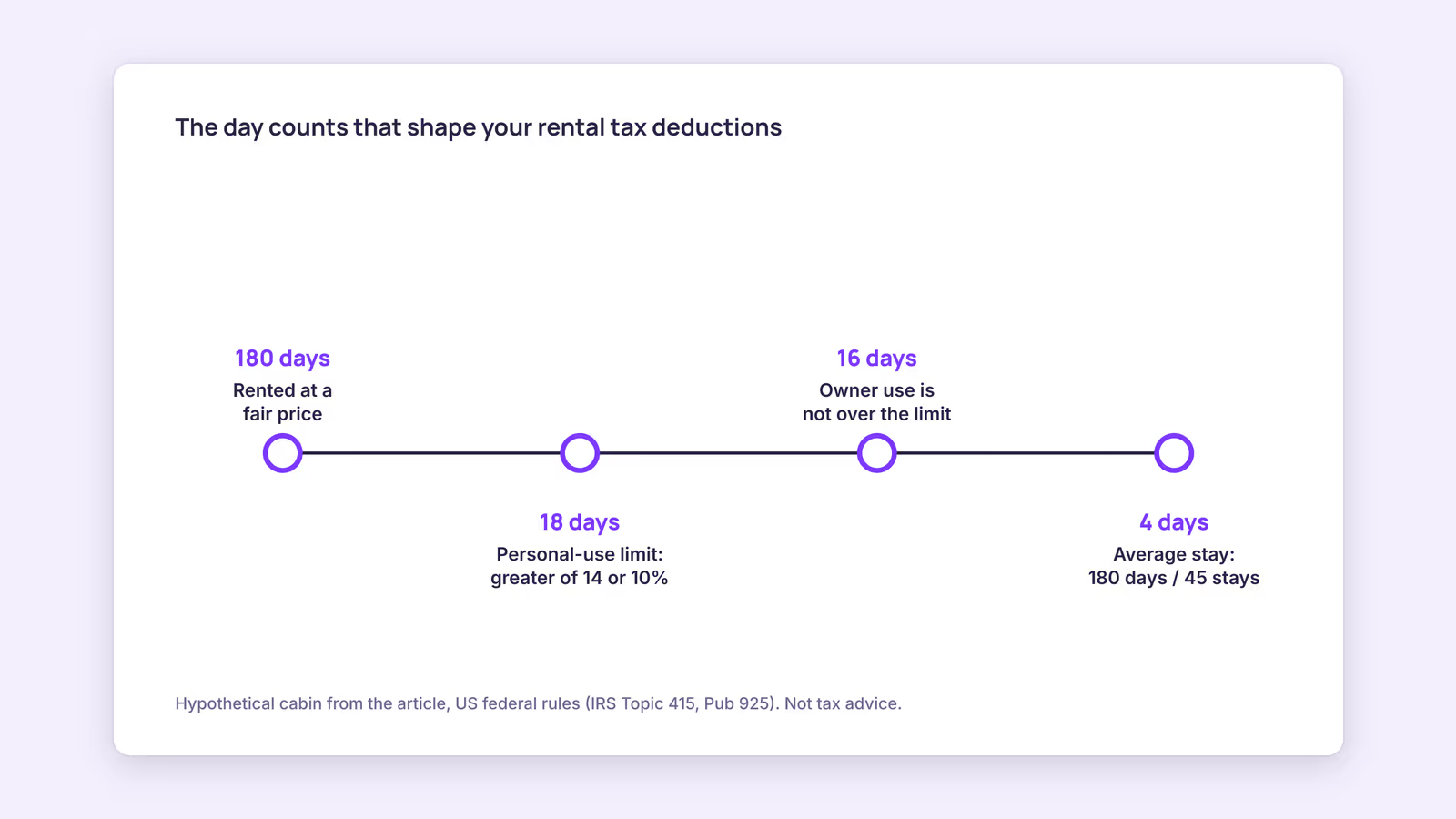
Here's a worked example. Consider a hypothetical cabin rented at a fair price for 180 days across 45 stays.
| Check | Hypothetical numbers | Result |
|---|---|---|
| Personal-use threshold | Greater of 14 days or 10% of 180 days | 18 days |
| Owner uses it 16 days | 16 is not more than 18 | Not treated as a residence |
| Owner uses it 20 days | 20 is more than 18 | Treated as a residence; deductions capped |
| Rental share of expenses | 180 rental days out of 196 total days used (16 personal) | About 91.8% of shared expenses |
| Average stay | 180 rental days divided by 45 stays | 4 days, which is 7 days or less |
The last row matters for the next question.
Does the short term rental tax loophole apply to you?
The short term rental tax loophole is a passive-loss exception: with an average stay of 7 days or less, your activity isn't a "rental activity," so material participation decides how losses are treated.
Normally, Topic 415 says rental losses are generally limited by the at-risk and passive activity loss rules. IRS Publication 925 lists exceptions to the definition of a rental activity. One applies when "the average period of customer use of the property is 7 days or less," figured by dividing total rental days by the number of rentals. Another applies when the average is 30 days or less and you provide significant personal services.
Why that matters: Pub 925 names two kinds of passive activities. One is rental activities, even when you materially participate, unless you're a real estate professional. The other is trade or business activities in which you don't materially participate. So once your activity falls outside the rental definition, material participation becomes the deciding question, and Pub 925 points you to the Form 8582 instructions for reporting. The material participation tests include, among others:
- You participated for more than 500 hours during the year.
- Your participation was substantially all the participation by anyone.
- You participated for more than 100 hours and at least as much as any other individual, including people with no ownership interest, such as a cleaner or manager.
This suggests that a host with short average stays who hands the property to a full-service manager may struggle to meet these tests, while a hands-on host might meet one. Hours logs matter here, so keep them as you go rather than rebuilding them in April.
Separately, Pub 527 says you generally report on Schedule C rather than Schedule E if you provide substantial services primarily for your guests' convenience, such as regular cleaning, changing linen or maid service. Which schedule applies, and what that means for self-employment tax, is a question for your tax professional.
How does depreciation work for the building and furniture?
Depreciation spreads the cost of the building and its contents over IRS recovery periods: 27.5 years for residential rental buildings and 5 years for furniture, appliances and carpets used in the rental.
Those periods come from Table 2-1 in Pub 527. Land isn't depreciable, so you separate the land value from the building value before you start. Consider a hypothetical building portion worth $275,000: $275,000 divided by 27.5 years is about $10,000 per full year, with a smaller amount in the first year because of the mid-month convention.
So, can you write off furniture for an Airbnb? Generally yes, but through depreciation over its recovery period rather than all at once, unless another option applies. Pub 527 notes that some property may qualify for a special depreciation allowance and points to IRS Publication 946 for the details. Check the Pub 946 edition for the year you're filing, not an older copy.
Some owners commission a cost segregation study to separate shorter-life components from the building. Whether that's worth the cost depends on your numbers and tax position, so treat it as a question for a specialist, not a default. If you're still deciding whether a property pencils out, run the vacation rental ROI math before tax benefits, not after.
When this advice does not apply
- This isn't tax advice. It summarizes IRS guidance for general education. Your facts, elections and filing status change the answer, so confirm deductions with a licensed tax professional before you file.
- Outside the US federal system: state and local income taxes, and every non-US country, have their own rules. Occupancy and tourist taxes are separate obligations from income tax.
- Other tax years: the IRS publications cited here are the editions for preparing 2025 returns. Check the current edition for the year you're filing.
- Entities and co-ownership: partnerships, LLCs and multi-owner arrangements have their own reporting. See our guide on whether you need an LLC for Airbnb.
- Real estate professionals, dealers and property sales: special rules apply that this guide doesn't cover.
What to do next
- Export last year's calendars and count rental days, number of stays and personal-use days per property.
- Collect Airbnb payout statements and Booking.com commission invoices so platform fees are documented.
- Sort last year's costs into expenses and possible improvements, and ask your preparer about the de minimis safe harbor election.
- Start an hours log now if your average stay is 7 days or less and you self-manage.
- Book time with a tax professional who works with short-term rentals before the filing deadline.
FAQ
Is Airbnb income taxable in the US?
Generally yes. Topic 415 says rental income is reported with deductible expenses, usually on Schedule E. The exception is a property you use as a residence and rent for fewer than 15 days in the year.
Are Airbnb and Booking.com fees tax deductible?
Commissions are on Pub 527's list of common rental expenses. Airbnb deducts its host fee from your payout and Booking.com invoices commission, so keep those records to support the deduction.
Which Airbnb tax deductible expenses are easy to overlook?
Our recommendation: check pre-rental costs from the date the property became available, legal and professional fees, advertising, and depreciation on furniture and appliances. All four appear in Pub 527's guidance on rental expenses.
About BookBed: BookBed Pro includes auto-invoicing and VAT reports, so the invoices for your bookings sit in one place when you sit down with your accountant. See Pro pricing
Sources
- IRS, "Topic no. 415, Renting residential and vacation property" — Verified 2026-09-30
- IRS, "Publication 527 (2025), Residential Rental Property (Including Rental of Vacation Homes)" — Verified 2026-09-30
- IRS, "Publication 925 (2025), Passive Activity and At-Risk Rules" — Verified 2026-09-30
- IRS, "Publication 946, How To Depreciate Property" — Verified 2026-09-30
- Airbnb Help Center, "Airbnb service fees" — Verified 2026-09-30