You look at a year of payouts, it looks like a lot of money, and you still aren't sure the property is paying off. Payouts aren't profit, and profit isn't return. To calculate vacation rental ROI honestly, you need three numbers from your own records: the cash you put in, the payouts you received after platform fees, and every running cost.
Start today by exporting last year's payout reports from each channel and your bank statements for the property. Estimates from market data tools are fine for a purchase you haven't made yet. For a property you already run, your statements beat any estimate.
What is vacation rental ROI and which formula should you use?
Vacation rental ROI is the yearly return a property produces relative to the money behind it. Two formulas cover most decisions: cap rate judges the property itself, and cash-on-cash return judges your actual cash.
Cap rate = net operating income ÷ purchase price. It ignores how you financed the purchase, so it's useful for comparing properties with each other.
Cash-on-cash return = (net operating income − annual mortgage payments) ÷ total cash invested. It tells you what your own money earns this year, loan included.
Net operating income (NOI) is payouts minus operating expenses, before mortgage payments. Keep the mortgage out of NOI and put it back in only for cash-on-cash. Mixing the two is the most common reason spreadsheets disagree.
Neither formula counts equity from loan paydown or price appreciation. Both are real, but they're separate from what the property earns this year, so track them on their own line.
How do you calculate ROI on a rental, step by step?
Add up the cash you invested, calculate payouts after platform fees, subtract operating costs to get NOI, then divide by price for cap rate or subtract debt service and divide by cash invested for cash-on-cash.
Here's a worked example. Consider a hypothetical $400,000 house bought with 20% down. Every number below is illustrative, so replace each one with yours.
1. Total cash invested
| Item | Amount |
|---|---|
| Down payment (20%) | $80,000 |
| Closing costs | $10,000 |
| Furnishing and setup | $15,000 |
| Initial repairs | $5,000 |
| Total cash invested | $110,000 |
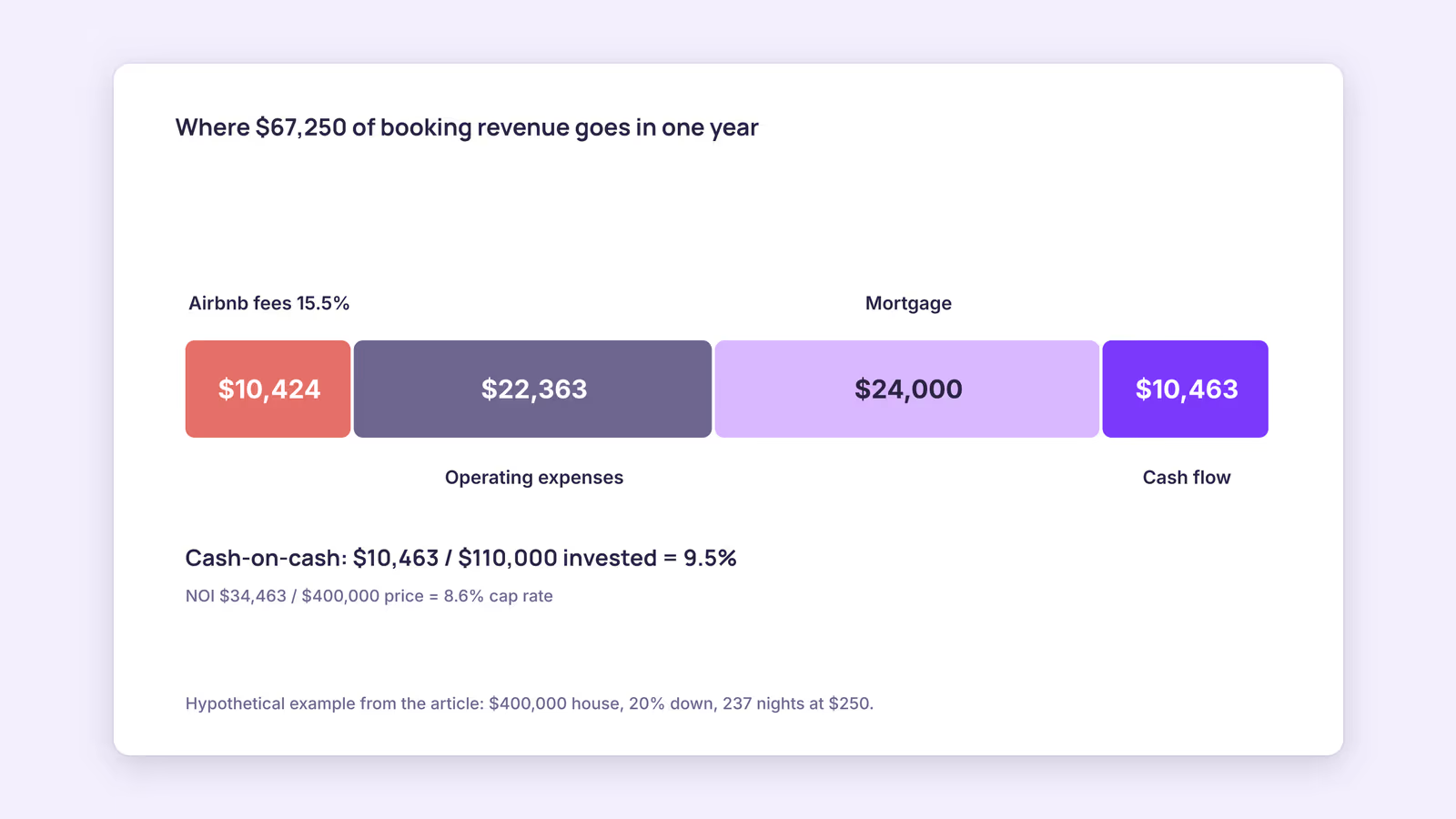
2. Booking revenue and platform fees. Say the property books 237 nights at $250 a night ($59,250) and you charge $8,000 in cleaning fees over the year, for $67,250 in booking revenue.
Platform fees come out before you're paid. Airbnb's service fee article says most hosts on its single fee structure pay 15.5%, others typically 14–16%, charged on the nightly price plus host fees such as cleaning, not on taxes. Booking.com's commission article says its rate depends on your country, property type and agreement, and applies to the room rate plus fees you charge. If you'd rather not work the fee out by hand, the Airbnb fee calculator does the payout breakdown.
In this example every booking comes through Airbnb at 15.5%: $67,250 × 0.155 = $10,424 in fees, leaving $56,826 in payouts.
3. Operating expenses (no mortgage)
| Expense | Annual amount |
|---|---|
| Property taxes | $4,000 |
| Insurance | $2,000 |
| Utilities and internet | $3,500 |
| Cleaning paid to cleaners | $8,000 |
| Supplies and consumables | $1,000 |
| Software | $500 |
| Maintenance reserve (5% of booking revenue) | $3,363 |
| Total operating expenses | $22,363 |
4. NOI and cap rate. $56,826 − $22,363 = $34,463 NOI. Cap rate = $34,463 ÷ $400,000 = 8.6%.
5. Cash flow and cash-on-cash return. With $24,000 a year in mortgage payments, cash flow is $34,463 − $24,000 = $10,463. Cash-on-cash return = $10,463 ÷ $110,000 = 9.5%.
Notice that platform fees ($10,424) are almost as large as the whole year's cash flow. That's why fees belong in the calculation as their own line, not buried inside "revenue."
What is a good cash-on-cash return for an Airbnb?
There's no universal good number. A cash-on-cash return is good if it beats what the same cash could earn elsewhere at similar risk, after you price in the time you spend running the property.
Our recommendation: set your own threshold before you look at listings or statements, then test it in three ways.
- Opportunity cost. What would $110,000 earn in a savings account or index fund you'd otherwise choose? The rental has to beat it by enough to cover the extra risk and work.
- Your time. If you self-manage, estimate your hours per month. Deduct what a manager or co-host would charge. If the return disappears, you're being paid a wage, not earning a return.
- Sensitivity. Rerun the numbers with fewer booked nights. In the example, each 10 nights lost at $250 cuts payouts by $2,113 after the 15.5% fee, about 1.9 points of cash-on-cash return. A return that only works at your best-case occupancy is fragile.
Use this checklist before you trust any result:
| Check | Why it matters |
|---|---|
| Revenue is payouts, not booking totals | Platform fees are already gone before cash lands |
| Mortgage is excluded from NOI | Otherwise cap rate double-counts financing |
| Cleaning appears as income and expense | Cleaning fees you charge are also fees you pay out |
| Maintenance reserve is included | Repairs are lumpy, but they're certain over time |
| Vacancy is based on your calendar | Market averages hide your own slow months |
| Your own hours are priced | Self-management has a cost even if you don't invoice it |
Taxes and depreciation are a separate layer. In the US, the IRS Publication 527 covers which rental expenses are deductible and how depreciation works. Talk to a tax adviser before you compare after-tax returns.
How can you raise the return on a rental you already own?
You can raise ROI by increasing payouts per booked night, filling more nights, or cutting running costs. Reducing the share of revenue lost to platform fees helps on every booking without changing your price.
- Price and fill. Review nightly rates against your own booking pace; see pricing tools for vacation rentals for the options.
- Cut fixed costs. Re-quote insurance, internet and software once a year.
- Shift some bookings to direct. Repeat guests and people who find you outside the platforms can book directly, where you pay card processing instead of a platform fee. Stripe's Ireland pricing page lists 1.5% + €0.25 for standard EEA cards, for example. Direct bookings bring their own costs, including marketing and handling payments and disputes yourself. Direct booking vs OTA walks through that trade-off.
This suggests a practical test: if moving 10% of your bookings to direct would add less than a few hundred dollars a year after the extra costs, focus on pricing and occupancy first.
When this advice does not apply
These formulas assume a single property held for rental income. If you use the home yourself for part of the year, split costs between personal and rental use, and the tax rules change too. If you're comparing properties across countries, fees, taxes and financing terms differ enough that you should build separate models. And if your goal is long-term appreciation rather than income, cash-on-cash return will understate what you care about.
What to do next
- Export 12 months of payout reports from every channel you use.
- Total your cash invested, including furnishing and repairs.
- Fill in the expense table with actual figures, plus a maintenance reserve.
- Calculate NOI, cap rate and cash-on-cash return.
- Rerun the numbers with 10 and 20 fewer booked nights and decide whether the result still clears your threshold.
FAQ
Is there a vacation rental ROI calculator I can use?
A spreadsheet with the five steps above works as a vacation rental ROI calculator. Use one row per input so you can change occupancy, rate and fees and see the result update.
Should I include the mortgage when I calculate Airbnb cash on cash return?
Yes. Cash-on-cash return subtracts mortgage payments from NOI. Cap rate doesn't, because it measures the property independent of how you financed it.
Should vacation rental return on investment include appreciation?
Track it separately. Appreciation and loan paydown build wealth, but they aren't cash you receive this year, so mixing them in makes weak cash flow look stronger than it is.
Direct booking widget: BookBed's embeddable booking widget takes payment through Stripe into your own Stripe account, with 0% BookBed commission on the booking. It won't bring you traffic, but it gives repeat guests a place to book. See plans and start a free trial
Sources
- Airbnb Help Center, "Airbnb service fees" — Verified 2026-09-30
- Booking.com for Partners, "Understanding your commission" — Verified 2026-09-30
- Stripe, "Pricing & fees" (Ireland) — Verified 2026-09-30
- Internal Revenue Service, "Publication 527, Residential Rental Property" — Verified 2026-09-30