You've got a rental listed, or you're about to, and someone told you to form an LLC for Airbnb before your first guest arrives. Maybe that's right for you. But an LLC isn't a switch you flip once: it's a separate legal entity with its own paperwork, rules, and costs that depend on your state, your mortgage, and your insurance.
Your first action: before filing anything, pull out three documents: your mortgage note, your insurance policy, and your state's business-filing page. Most of the decision lives in those three places.
This article is general information for US hosts. It is not legal or tax advice. Talk to a licensed attorney and a CPA in your state before you form an entity or move a property.
What does an LLC for Airbnb actually protect?
An LLC is a state-created business entity that can separate business liabilities from your personal assets, but that protection has limits and depends on how you set up and run the company.
The US Small Business Administration describes LLCs as protecting you from personal liability "in most instances," so personal assets like your car, house, and savings aren't at risk if the LLC faces bankruptcy or lawsuits. The same page notes that a sole proprietorship creates no separate entity, so business debts and obligations can reach you personally.
Two caveats matter for hosts:
- "In most instances" is not "always." How courts treat an LLC depends on state law and on your conduct. Commingling rental income with personal money, or skipping the LLC's own formalities, can weaken the separation. Ask your attorney what your state expects.
- The LLC only shields what it owns. If the property stays in your personal name and only the "business" is in the LLC, the separation may not cover what you think it does.
The IRS also points out that LLCs are allowed by state statute and that each state may use different regulations, so check your own state's rules first.
Sole proprietorship vs LLC for Airbnb: how do they compare?
The main differences are personal liability exposure, paperwork, financing, and ownership flexibility; federal income tax often looks similar for a single owner because a one-member LLC is usually disregarded.
| Question | Sole proprietorship (no entity) | Single-member LLC | Multi-member LLC |
|---|---|---|---|
| Separate legal entity? | No, per SBA | Yes, under state law | Yes, under state law |
| Default federal income tax treatment | Reported on your own return | Disregarded entity, reported on your return, unless it elects corporate treatment | Partnership, unless it elects corporate treatment |
| Formation and upkeep | None beyond local licensing | State filing plus ongoing state requirements | State filing, ongoing requirements, operating agreement between owners |
| Mortgage impact | Easiest to finance in your own name | Moving a financed home into it may trigger loan terms; ask your lender | Same, plus lender review of all owners |
| Good fit when | Testing a low-risk rental | Separating one or more rentals from personal assets | Co-owning with someone other than yourself |
Sources for the tax rows: the IRS pages on LLCs and single-member LLCs. The IRS says a domestic LLC with at least two members is a partnership by default, and a one-member LLC is disregarded for income tax unless it files Form 8832 to be treated as a corporation.
Insurance sits beside all three columns. An LLC doesn't pay a claim; an insurance policy does. Our recommendation: get the right short-term rental coverage first, then decide on the entity. Our vacation rental insurance guide covers what to ask your insurer.
How are Airbnb LLC taxes handled?
For most single-owner hosts, a default LLC doesn't change federal income tax much: the IRS disregards a one-member LLC and its activity goes on your own Form 1040, usually Schedule C or Schedule E.
According to the IRS single-member LLC page, an individual owner's disregarded LLC is generally reported on Schedule C, Schedule E, or Schedule F, and an owner operating a trade or business pays self-employment tax the same way a sole proprietor would. Which schedule applies to a short-term rental depends on the facts, including the services you provide. That's a question for your CPA, not a default.
A few other IRS points hosts ask about:
- EIN: a disregarded single-member LLC without employees or excise tax liability doesn't need its own EIN for federal tax, but may get one if a bank or state law requires it.
- Personal use still counts. IRS Topic 415 says that if you personally use a unit for more than the greater of 14 days or 10% of the days it's rented at a fair price, it's treated as a residence and deductions are limited. Putting the home in an LLC doesn't make those days disappear.
- Two spouses owning an LLC in a non-community-property state should generally file as a partnership, per the IRS, with special rules in community property states.
State taxes, lodging taxes, and annual entity fees vary by state and city. We don't list amounts here because they change and differ widely; check your Secretary of State and state revenue department. Our vacation rental tax deductions post covers expense tracking in more detail.
Should I put my Airbnb in an LLC? A decision checklist
Work through these questions in order. Each "yes" is a reason to book a meeting with an attorney and CPA; each "no" is a reason the LLC may be able to wait.
| # | Question | If yes | If no |
|---|---|---|---|
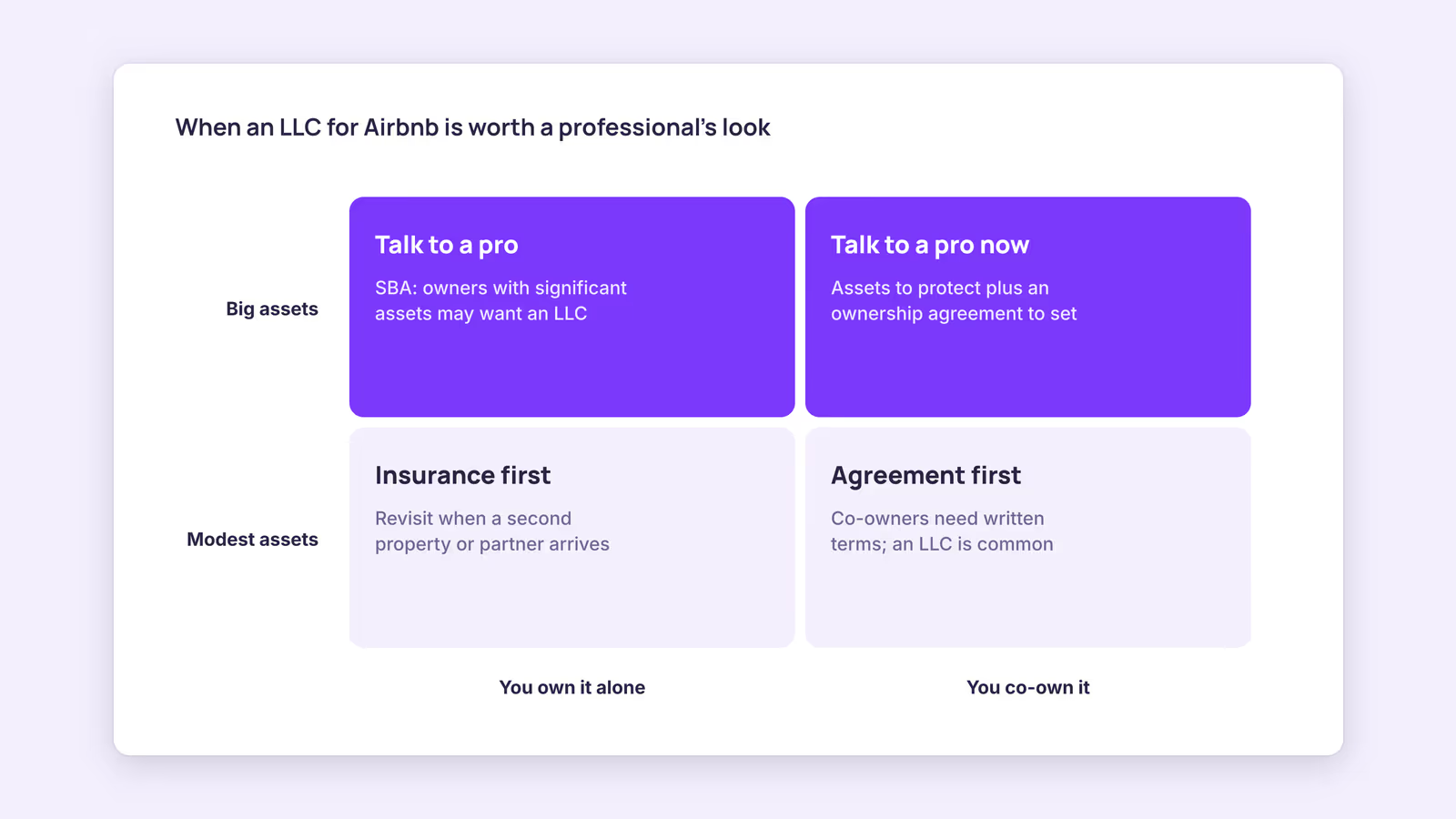
| 1 | Do you co-own the rental with anyone other than yourself? | A written operating agreement matters; an LLC is a common way to set one | Single ownership keeps options open |
| 2 | Do you have significant personal assets beyond the rental? | SBA lists this as a reason to consider an LLC | Adequate insurance may be your main protection for now |
| 3 | Is the property financed in your personal name? | Read the transfer clauses and ask your lender before deeding it | Transfer is simpler, but still check title and insurance |
| 4 | Will your insurer cover a property owned by an LLC? | Update the named insured before any transfer | Shop for a policy before forming the entity |
| 5 | Do you own or plan several rentals? | Discuss whether one or several entities fit your risk | One property may not justify the upkeep |
| 6 | Does your city's short-term rental permit name a specific owner? | Confirm whether a transfer requires a new permit | No extra permit step |
Consider a hypothetical host with one financed condo, no co-owner, modest savings, and a solid short-term rental policy. Questions 1, 2, and 5 are "no," and question 3 raises a lender issue. This suggests that host's first dollar is better spent on insurance and clean bookkeeping, with the LLC revisited when a second property or partner arrives. A different host co-buying a cabin with a friend hits question 1 immediately and likely needs an agreement before closing.
For the permit question, see our short-term rental regulations guide.
When this advice does not apply
- Outside the US. LLCs are a US state-law entity. In Croatia, the EU, or elsewhere, legal forms, tax registration, and tourist-tax rules differ completely.
- Rental arbitrage. If you lease rather than own, your lease terms and landlord consent come before any entity question.
- Existing LLCs or trusts. If the property already sits in a trust or entity, restructuring can have tax and title consequences only a professional should assess.
- Corporate tax elections. Electing S corporation or C corporation treatment is a separate decision with its own IRS filings.
What to do next
- Read your mortgage note for transfer or "due-on-sale" language, then ask your lender directly how it treats a transfer to an LLC.
- Call your insurer and ask whether your short-term rental policy covers an LLC-owned property and who must be named.
- Visit your Secretary of State's website for current formation and annual requirements in your state.
- Bring the checklist above to a CPA and a real estate attorney, and ask which Schedule your rental belongs on.
- If you do form an LLC, open a separate bank account and route all rental income and expenses through it.
FAQ
How do I put my Airbnb in an LLC?
Generally you form the LLC with your state, then transfer the property by deed. Before you do, talk to your lender, insurer, and attorney, because the transfer can affect your mortgage, title insurance, coverage, and local permits.
Is an LLC for Airbnb property worth it with one unit?
It depends on your assets, financing, and insurance. SBA says LLCs suit medium- or higher-risk businesses and owners with significant personal assets, while sole proprietorships can suit low-risk owners testing an idea.
Does an LLC lower my Airbnb taxes?
Not by default. A single-member LLC is disregarded for federal income tax unless it elects corporate treatment, so the rental's income generally lands on your own return either way.
One thing BookBed does here: if your LLC has its own Stripe account, the BookBed direct booking widget sends guest payments straight into that account, with only Stripe processing fees and 0% BookBed commission, so direct-booking revenue lands in the business's books rather than yours.
Sources
- IRS, "Limited liability company (LLC)" — Verified 2026-09-30
- IRS, "Single member limited liability companies" — Verified 2026-09-30
- IRS, "Topic no. 415, Renting residential and vacation property" — Verified 2026-09-30
- US Small Business Administration, "Choose a business structure" — Verified 2026-09-30