You're changing nightly rates by hand, you suspect you're leaving money on the table, and every search for the best Airbnb pricing software returns a list of vendors with no way to compare them. The honest answer is that there's no single best tool. There's a best fit for your unit count, your seasonality and the way your rates reach each channel.
Start with one action today: export the last 12 months of bookings and write down, per unit, your gross booking revenue and how many months had zero or near-zero income. Those two numbers decide which fee model is cheaper for you, before you look at a single feature.
Is Airbnb Smart Pricing good enough, or do you need dynamic pricing software for Airbnb?
Smart Pricing is free and adjusts rates inside Airbnb, but it only controls Airbnb; if you also sell on Booking.com, Vrbo or a direct site, you need a separate tool or manual work to price those channels.
Airbnb says Smart Pricing uses "hundreds of factors about your listing and your area" to set your nightly price based on demand, within a minimum and maximum you choose. You can override individual nights in the calendar. Two limits matter. First, discounts you add can push the guest price below your Smart Pricing minimum. Second, Airbnb states that Smart Pricing overrides rule-sets, so you have to turn it off to use them.
The common claim that Smart Pricing is "designed to underprice you" isn't something Airbnb's documentation supports or refutes, so treat it as opinion. A fairer test: set a minimum you'd genuinely accept, run it for a month, and compare booked rates against your own pace from last year.
A third-party tool earns its fee when you need one or more of these:
- the same pricing logic across several channels
- rules Smart Pricing can't express, such as last-minute or gap-night adjustments you define yourself
- market data about comparable listings to set your base price
- portfolio-level reporting across many units
If none of those apply, Smart Pricing plus a careful minimum is a reasonable place to stay. For the concepts behind all of this, read dynamic pricing explained.
How do the best Airbnb pricing software tools differ on cost?
The main difference is the fee model: Wheelhouse publishes both a flat per-listing price and a percentage-of-revenue option, while PriceLabs and Beyond don't show list prices in plain text on their plan pages as of this check.
Here's what each vendor states on its own site, verified on 2026-09-30:
| Tool | What the vendor publishes | Trial |
|---|---|---|
| Airbnb Smart Pricing | Built into Airbnb, no separate fee; min and max price you set | Not applicable |
| Wheelhouse Pro Flex | 1% of revenue, $2.99 minimum monthly fee, billed at reservation, excludes taxes and fees | Free to start |
| Wheelhouse Pro Flat | $19.99 per listing per month; $16.99 for 10–49 listings; 50+ listings contact sales | Free to start |
| PriceLabs | Plan page offers a 30-day free trial; check the live page for current per-listing prices | 30 days |
| Beyond | Positions itself as a revenue manager for portfolios; no public list price found in this check | Contact vendor |
Sources: Wheelhouse plans, PriceLabs plans, Airbnb Smart Pricing.
We removed specific PriceLabs and Beyond prices from an earlier version of this post because we couldn't confirm them against the vendors' current pages. Get a written quote before you compare.
Which airbnb price management software fee model is cheaper for you?
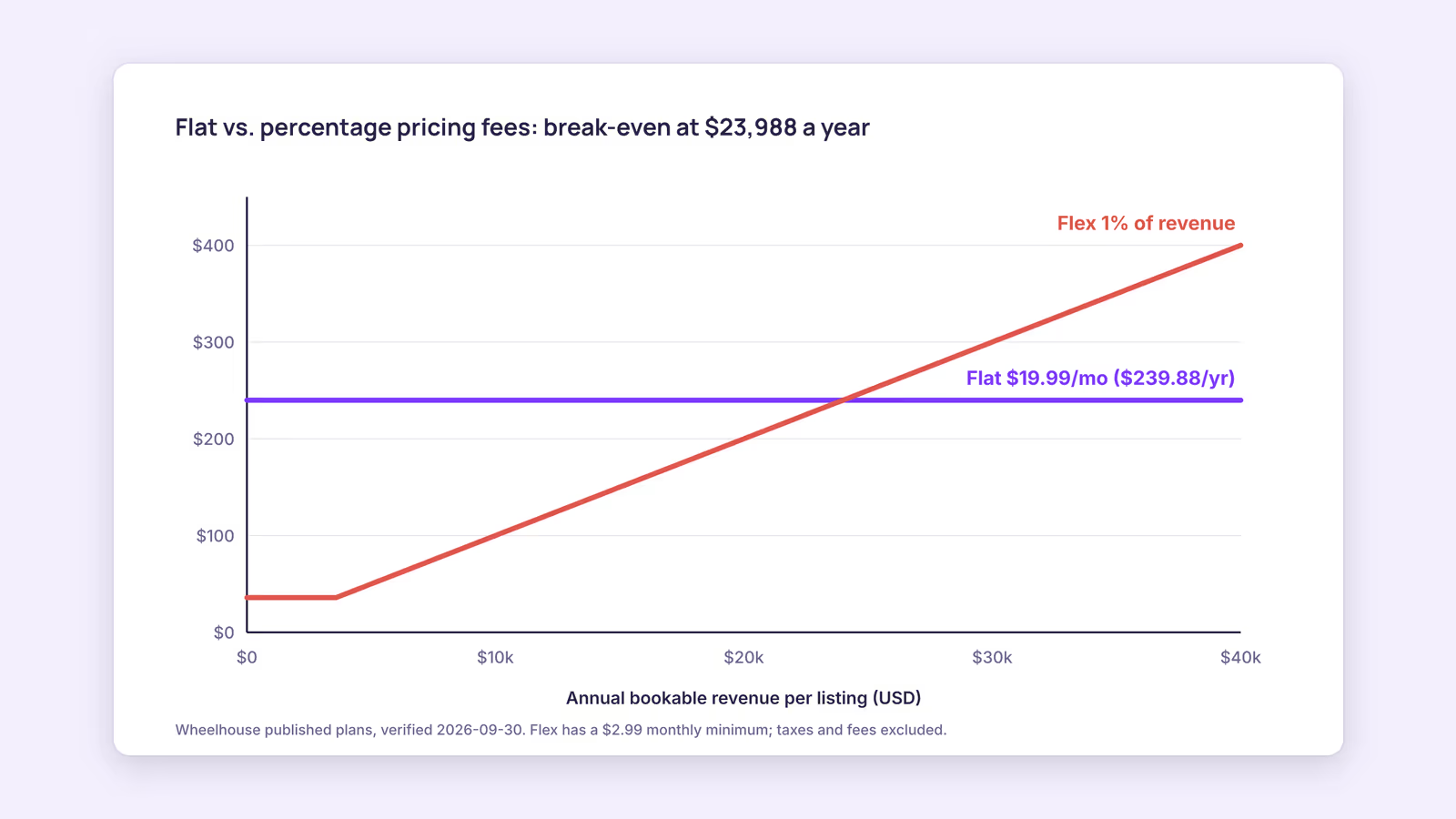
A flat per-listing fee is cheaper when a unit earns steadily all year; a percentage fee is cheaper when a unit earns little for several months, because you pay almost nothing in those months.
Here's a worked break-even using Wheelhouse's published numbers only. Flat costs $19.99 a month, or $239.88 a year per listing. Flex costs 1% of revenue, so it matches the flat price when a listing grosses $23,988 a year in bookable revenue (taxes and fees excluded, per Wheelhouse). Below that, Flex costs less. Above it, Flat costs less. The $2.99 monthly minimum means a dead month still costs something on Flex.
Consider a hypothetical coastal apartment that grosses $18,000 in rent across five summer months and nothing in winter. Flex would cost about $180 plus the $2.99 minimum in each of the seven empty months, roughly $201 in total, against $239.88 on Flat. A hypothetical city unit grossing $40,000 evenly would pay about $400 on Flex versus $239.88 on Flat.
Use this checklist to pick your model and shortlist:
| Your situation | Lean toward |
|---|---|
| One channel (Airbnb only), under 3 units, want minimal setup | Smart Pricing with a firm minimum |
| Seasonal unit with several empty months | Percentage-of-revenue plan |
| Year-round unit grossing above the break-even | Flat per-listing plan |
| Several channels that must share one rate logic | A pricing tool that connects to all of them, often through a PMS |
| Over 50 units | Request enterprise quotes from each vendor |
Our recommendation: run your own numbers through the break-even formula (annual flat fee divided by the percentage rate) for each vendor you quote, rather than trusting any "cheapest" label.
How do you connect PriceLabs to Airbnb and your other channels?
Pricing tools push rates either straight to Airbnb or through a property management system that holds an API connection to each channel; iCal calendar links can't carry prices at all.
This is the part most comparisons skip. iCal sync shares busy dates only; the RFC 5545 calendar format it uses describes events, not nightly rates. It carries no rates, minimum stays or discounts. So if your channels are linked only by iCal, a pricing tool can update Airbnb, but your Booking.com rates stay wherever you last set them.
Before you buy, ask each vendor three questions and get the answers in writing:
- Which channels or PMS platforms do you push rates to directly?
- What happens if a sync fails, and how will I find out?
- Can I set a different minimum price or markup per channel?
If your PMS is the hub, check that it accepts rates from your chosen tool before signing a contract. A vacation rental PMS that syncs only via iCal won't pass prices through. Keeping rates aligned across channels is its own discipline; see rate parity for how to set per-channel markups on purpose.
When this advice does not apply
- If you only list on one platform that sets prices for you (some hotel-style or managed programs), third-party pricing may not be permitted or useful.
- Mid-term and monthly rentals price on different signals; check whether a tool supports length-of-stay pricing before relying on nightly logic.
- Vendor prices and plans change often. Every figure here reflects what the vendor published on 2026-09-30.
- This post doesn't cover tax or VAT on software subscriptions, which depends on your country.
What to do next
- Pull 12 months of revenue per unit and mark the empty months.
- Calculate the flat-versus-percentage break-even for each tool you're considering.
- Test Smart Pricing or a free trial with a minimum price you'd genuinely accept.
- Ask each vendor which channels it pushes rates to, and confirm your PMS accepts them.
- Review booked rates against last year's pace after 30 days, then decide.
FAQ
Is PriceLabs better than Airbnb Smart Pricing?
It depends on your setup. PriceLabs is a separate paid tool that can work across channels; Smart Pricing is free but only prices Airbnb. If you sell on one channel and are happy with a firm minimum, Smart Pricing may be enough.
Can I use Smart Pricing and a third-party tool at the same time?
Not sensibly. Two systems setting the same night's price will overwrite each other. Turn Smart Pricing off when you connect an outside tool.
Why isn't my pricing tool changing Booking.com rates?
Usually because the channel isn't connected by API. Check the tool's integration list and your PMS connection; an iCal link alone moves availability, not prices.
About BookBed: If you take direct bookings, BookBed lets you set seasonal pricing rules for your own embeddable booking widget, so your direct rates follow the season you define. These rules apply to BookBed's calendar and widget, not to Airbnb or Booking.com. Try BookBed Pro
Sources
- Airbnb, "Use Smart Pricing to automatically adjust your prices based on demand" — Verified 2026-09-30
- Wheelhouse, "Plans & Pricing" — Verified 2026-09-30
- PriceLabs, "Pricing Plans" — Verified 2026-09-30
- IETF, "RFC 5545: Internet Calendaring and Scheduling Core Object Specification (iCalendar)" — Verified 2026-09-30