Your listing brought in a healthy-looking total last year, but your bank balance doesn't match. That gap is the difference between gross revenue and profit, and your Airbnb profit margin is the number that measures it. Before you change prices or cut anything, do one thing: pull last year's payouts and every bill tied to the property into one sheet. You can't judge a margin you haven't calculated with all its costs.
This guide shows the formula, a worked example with labelled assumptions, and a checklist for finding the cost lines that quietly shrink your margin.
How do you calculate your Airbnb profit margin?
Divide your net operating income by gross booking revenue and multiply by 100, where net income is everything guests paid minus platform fees, cleaning, utilities, supplies, maintenance, insurance, software and financing costs.
Profit margin = (Gross revenue − Total costs) ÷ Gross revenue × 100
Two definitions matter before you start:
- Gross revenue is what guests paid for the stay: nightly rates plus fees you charge, such as cleaning or pet fees. Leave out occupancy taxes you collect and pass on; that money was never yours.
- Total costs include the platform's cut. On Airbnb, host fees depend on your fee structure: the split fee is 3% for most hosts but is being phased out, while the single host-only fee is 15.5% for most hosts (14–16% for others). The fee applies to the nightly price plus host fees like cleaning, not taxes. On Booking.com, commission is a set percentage of the total booking amount, including cleaning and other fees, and the rate depends on your country, property type and agreement.
If you want to see what one booking actually pays out before costs, the Airbnb fee calculator breaks it down.
A worked example
Consider a hypothetical one-unit host. These numbers are illustrative inputs, not benchmarks.
| Line | Annual amount |
|---|---|
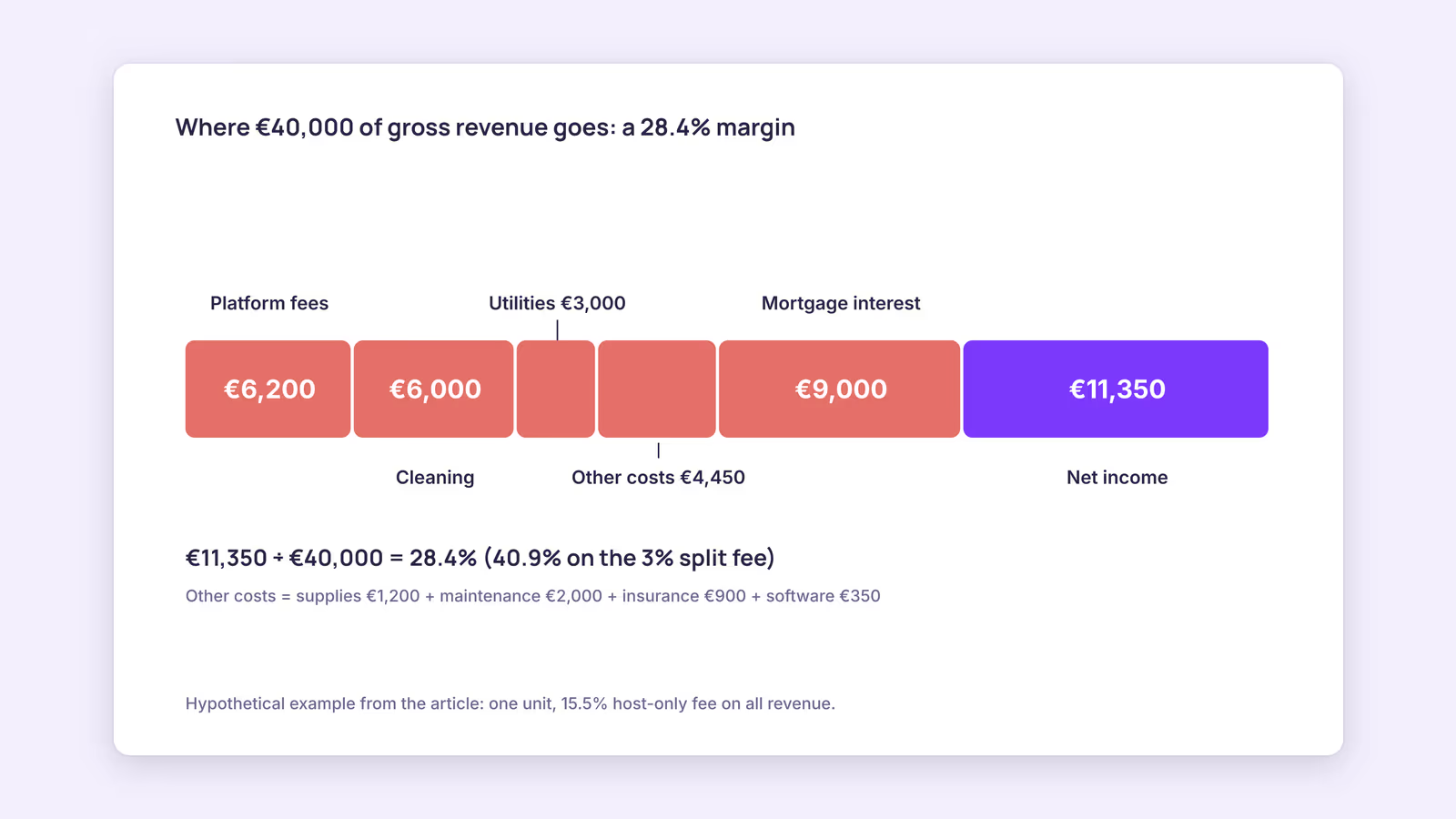
| Gross booking revenue (rates + cleaning fees) | €40,000 |
| Platform fees (15.5% single fee on all of it) | €6,200 |
| Cleaning and laundry | €6,000 |
| Utilities and internet | €3,000 |
| Supplies and consumables | €1,200 |
| Maintenance and repairs | €2,000 |
| Insurance | €900 |
| Software | €350 |
| Mortgage interest (or rent, if you sublet) | €9,000 |
| Total costs | €28,650 |
Net income is €40,000 − €28,650 = €11,350. The margin is €11,350 ÷ €40,000 × 100 = 28.4%.
Now change one input. If the same host were on the 3% split fee, platform fees drop to €1,200 and the margin rises to 40.9%. That's why you should confirm which fee structure you're on before comparing yourself to anyone else. Airbnb says the host-only fee is mandatory for hosts using property management software and hosts in some countries, and that you can't switch back after migration.
What is a good profit margin for a short-term rental?
There's no reliable universal figure, because the same property can show a very different short-term rental profit margin depending on financing, who manages it, which platform fees apply, and whether you own or rent it.
We couldn't find a primary source that publishes an average Airbnb profit margin for hosts, and search results for that phrase often mix in Airbnb the company's own corporate margins, which say nothing about your listing. So instead of a target number, compare your margin against your own situation:
| Your situation | What drives the margin | What to compare against |
|---|---|---|
| Owned outright | No financing cost, so margins look high | What the money would earn elsewhere, plus a reserve for big repairs |
| Owned with a mortgage | Interest is often the largest single cost | Whether net income covers principal repayments too, not just interest |
| Rental arbitrage (subletting) | Rent is a fixed cost paid every month, booked or not | Worst realistic month: does revenue still cover rent? |
| Paid co-host or manager | Management fee comes off the top | Your margin if you self-managed, minus the value of your own time |
Our recommendation: treat any Airbnb arbitrage profit margin with extra caution. Because rent is due in empty months too, a margin that looks fine across a full year can hide several loss-making months you'd have to fund in cash.
Also remember that the formula above measures operating profit. Mortgage principal, furniture replacement and income tax sit outside it or only partly inside it. For the investment view, calculate your ROI separately.
Which costs shrink an Airbnb host profit margin most often?
The costs that most often go missing are the ones that scale with bookings or arrive irregularly: platform fees on cleaning charges, payment processing, restocking, damage repairs, and annual bills paid outside the booking cycle.
Use this checklist against last year's records. Any "no" is a line to add or fix before you trust your number.
- Did you use payouts, not listing prices, as revenue? Payouts already have host fees removed, so either start from gross and subtract fees, or start from payouts and don't subtract fees again.
- Did you count fees charged on cleaning? Both Airbnb and Booking.com apply their fee or commission to cleaning charges, not only the nightly rate.
- Did you include card processing on any direct bookings? In Stripe's published Ireland pricing, standard EEA cards cost 1.5% + €0.25 per charge, with premium EEA cards at 2.8% + €0.25.
- Did you include irregular costs? Annual insurance, licence or registration fees, furniture and linen replacement, deep cleans.
- Did you separate taxes you collect from income you keep? Occupancy or tourist tax passed through to authorities isn't revenue.
- Did you allocate shared costs honestly? If you use the property yourself part of the year, only the rental share of costs belongs in the calculation. Tax rules on this vary by country, so check with a local adviser.
Once your number is complete, you have two levers. On the revenue side, review your nightly rates against demand; our guide to increasing vacation rental revenue covers pricing and add-on fees. On the cost side, look at the biggest percentage costs first, since platform fees grow with every booking while most fixed costs don't.
Direct bookings can reduce the platform-fee line for repeat or referred guests, but they aren't free: you pay card processing, you have to bring the traffic yourself, and Airbnb's off-platform policy prohibits moving Airbnb guests' future bookings off Airbnb. This suggests direct booking is a supplement to OTA income for most small hosts, not a replacement.
When this advice does not apply
- Multi-unit portfolios. Calculate margin per unit as well as in total, or a strong unit can hide a weak one.
- Hotels and serviced apartments. Airbnb applies the host-only fee to these categories, and staffing costs change the picture entirely.
- Tax reporting. The margin here is a management tool. What's deductible, and how, depends on your country's tax rules.
What to do next
- Export last year's payouts from each platform and total your gross revenue.
- Confirm which Airbnb fee structure you're on and what Booking.com commission rate your invoices show.
- Fill in the worked-example table with your own lines and run the checklist.
- Recalculate with your worst month only, especially if you rent the property you list.
- Pick the single largest cost line and decide whether it can realistically change this season.
FAQ
Is there an Airbnb profit margin calculator?
You can use the formula and table above in any spreadsheet. For the fee part specifically, the Airbnb fee calculator shows how split and host-only fees change a payout.
Why do searches for Airbnb's profit margin show billions?
Many results describe Airbnb, Inc. as a company, its revenue and corporate margins. That's unrelated to what you earn as a host.
Should I count my own time as a cost?
For deciding whether to hire a manager or co-host, yes. Put a value on your hours and compare it with the management fee, so the comparison is fair.
About BookBed: If direct bookings are part of your plan, BookBed's embeddable direct booking widget takes payment through Stripe into your own Stripe account, with 0% BookBed commission on each booking. Try BookBed Pro
Sources
- Airbnb Help Center, "Airbnb service fees" — Verified 2026-09-30
- Booking.com for Partners, "Understanding your commission" — Verified 2026-09-30
- Stripe, "Pricing" (Ireland) — Verified 2026-09-30
- Airbnb Help Center, "Off-Platform policy" — Verified 2026-09-30
- BookBed, "Pricing" (public/pricing.md) — Verified 2026-09-30