You're looking at a monthly software fee and wondering whether it will pay for itself. Most PMS ROI claims answer that with borrowed numbers: hours saved you never measured, revenue uplift nobody can trace. This guide gives you a formula you fill in with your own figures instead.
Start with one action today: open your Airbnb account and check which service fee structure your listings use. That single setting can change the answer more than the subscription price does, and most ROI calculations leave it out.
How do you calculate PMS ROI?
PMS ROI is the money a property management system brings in or saves, minus everything it costs you, divided by that total cost. Count only gains you can trace to the software and every cost it adds.
Written out:
ROI = (measured gains − total annual cost) ÷ total annual cost
The two sides break down like this:
- Measured gains = commission you no longer pay on bookings that moved from an OTA to your own channel + the value of hours you've timed yourself + expected savings from problems the software prevents
- Total annual cost = subscription + payment processing on direct bookings + any change in your Airbnb host service fee + your setup time, if you value it
Two rules keep this honest. First, a direct booking only counts as a gain if that guest would otherwise have booked through an OTA. A booking from someone who found your website anyway was never going to cost you commission. Second, time saved counts only after you've measured it. Log how long messaging, calendar checks and invoicing take for one month before you switch, then again after.
If you prefer thinking in months, use the payback version, often called the roi period formula:
Payback period (months) = total annual cost ÷ (measured annual gains ÷ 12)
What costs belong in a property management system cost estimate?
A full property management system cost estimate includes the subscription, card processing on direct payments, any Airbnb fee change triggered by the software, and your setup time. The subscription is often the smallest line.
Here's what to put in each cost line:
- Subscription. Use the billing period you'll actually choose. Flat monthly plans are easy to model; percentage-of-revenue plans grow with your bookings. The trade-offs between these models are covered in our PMS pricing models guide.
- Payment processing. Direct bookings aren't free to collect. Stripe's published pricing for Ireland lists 1.5% + €0.25 for standard European Economic Area cards and 2.8% + €0.25 for premium ones. Check the rate for your own country and card mix.
- The Airbnb host service fee. This is the cost most hosts miss. Airbnb's service fee article describes two structures. Under the split fee, most hosts pay 3% and guests pay a separate service fee. Under the single fee, the whole fee comes out of your payout: most hosts pay 15.5%, others typically 14–16%. Airbnb says the single fee is mandatory for several groups, including "hosts who use property management software," and that you can't switch back once migrated.
- Setup and switching time. Importing units, reconnecting calendars and testing all take hours. Value them at whatever rate you use for your own time, or leave them out and say so.
On the fee line: the single fee is charged on the nightly price plus host fees like cleaning, not on taxes. If you're already on the single fee, this line is zero. If you're on the split fee, the extra cost is roughly the fee difference times your annual Airbnb booking subtotal. Airbnb doesn't publish exactly which software setups trigger the change, so check your fee setting before and after you connect any tool. Our comparison of host-only vs split fees covers how hosts respond with pricing.
What does a worked PMS ROI example look like?
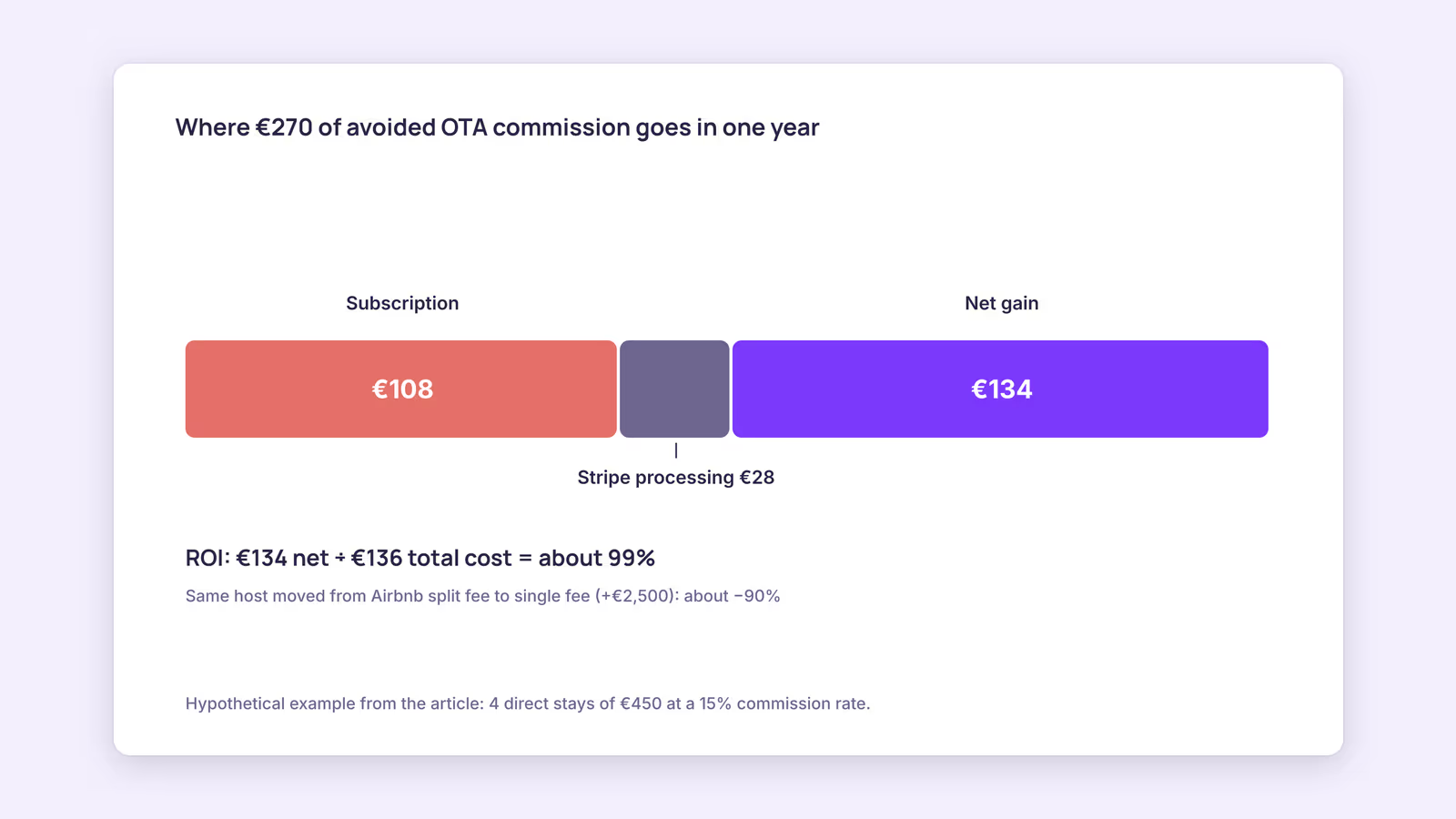
In this hypothetical example, a host who moves four €450 stays from an OTA to direct booking gets about a 99% return, unless the software also moves their Airbnb listings from the split fee to the single fee.
Consider a hypothetical two-unit host. Every input below is an assumption for illustration, not a typical result:
- Subscription: €108 a year (for example, a €9/month plan billed annually)
- Four stays of €450 each move from Booking.com to direct booking, and the host is confident those guests would otherwise have booked on Booking.com
- Their Booking.com commission rate: 15% (a hypothetical input; your rate depends on your contract)
- Time saved: counted as zero, because the host hasn't measured it yet
- Airbnb booking subtotal: €20,000 a year
Booking.com's commission page says commission is a set percentage of the total booking amount, including cleaning and other fees, and that the exact rate depends on country, property type and agreement.
| Line | Scenario A: already on single fee | Scenario B: moved from split to single fee |
|---|---|---|
| Commission avoided (4 × €450 × 15%) | €270 | €270 |
| Subscription | €108 | €108 |
| Stripe processing (1.5% of €1,800 + 4 × €0.25) | €28 | €28 |
| Airbnb fee change (15.5% − 3% on €20,000) | €0 | €2,500 |
| Total annual cost | €136 | €2,636 |
| Net result | +€134 | −€2,366 |
| ROI | about 99% | about −90% |
Scenario A has a payback period of about six months (€136 ÷ €22.50 a month). Scenario B never pays back at this volume. Each direct booking in this example nets €60.50 (€67.50 commission avoided minus €7.00 processing), so Scenario A breaks even after two bookings and Scenario B needs about 44.
Scenario B assumes the host keeps nightly prices unchanged after the switch. Under the single fee, guests no longer pay Airbnb's separate guest service fee, so the listed price can rise without the guest's total rising by as much. Whether your guests accept that is something you'd have to test, and it's why Scenario B is a worst case, not a forecast.
Is a PMS worth it if you only count gains you can measure?
A PMS is worth it when traced gains exceed every cost for your own setup. For many small hosts the deciding numbers are the Airbnb fee line and how many bookings truly move direct.
Use this quick diagnosis before you commit:
| If this is true | Your ROI hinges on | What to measure first |
|---|---|---|
| You're on Airbnb's split fee | Whether the tool changes your fee structure | Your fee setting before and after connecting |
| You have repeat guests who ask to book again | How many of them rebook directly | Repeat inquiries per season |
| You've had double bookings before | The expected cost of the next one | Past incidents and what each cost |
| You spend hours on messages and invoices | Real time saved | One month of time logs, before and after |
| Your stays are mostly one or two nights | Processing and commission per booking | Average booking value by channel |
Double bookings deserve a note. Airbnb's host cancellation policy charges hosts who cancel 10%, 25% or 50% of the reservation amount depending on timing, with a $50 minimum, and may block the listing's calendar for those dates. If you've had one before, multiply its cost by how often it happened to get an expected annual saving. If you've never had one, don't add a number. Our guide to avoiding double bookings covers the calendar setup side.
Our recommendation: run the formula twice, once with only commission avoided as your gain, and once including the time you've actually logged. If the first version is already positive, the decision is easy. If only the second one is, check that your time estimate is real.
When this advice does not apply
- If a property manager or co-host runs your listings, their fees and tools shape your costs more than any subscription. Ask them how their software affects your Airbnb fee structure.
- If your direct bookings come from a hotel-style booking engine with its own commission, add that rate to the cost side.
- If you sell only on one OTA and never take direct bookings, the commission line is zero and ROI depends on time saved and error prevention alone.
- Tax treatment of short term rental expenses like software varies by country. This guide doesn't cover deductions; ask your accountant.
What to do next
- Check your Airbnb service fee structure and write down your annual Airbnb booking subtotal.
- Pull last year's commission invoices from each OTA and note your real rate.
- Log one month of time on messaging, calendars and invoicing before trying any tool.
- Fill in the formula with Scenario A and Scenario B versions of your own numbers.
- During a free trial, recheck your Airbnb fee setting after connecting calendars, before you commit.
FAQ
What is the roi period formula for rental software?
Divide total annual cost by your average monthly measured gain. The result is the number of months until the software has paid for itself. If gains are seasonal, use the actual months they arrive instead of an average.
Does using a PMS change my Airbnb host service fee?
It can. Airbnb lists hosts who use property management software among those for whom the single host-only fee is mandatory. If you're already on the single fee, nothing changes. If you're on the split fee, check your settings after connecting any tool.
Can one direct booking pay for a year of software?
In the hypothetical example above, one €450 direct booking nets €60.50 at a 15% commission rate. That covers more than half of a €108 annual subscription, but not all of it. Your answer depends on your booking value and commission rate.
Direct booking widget: BookBed's embeddable booking widget takes payment through Stripe checkout into your own Stripe account, with 0% BookBed commission, so each booking that genuinely moves direct shows up in the gains side of your ROI. It won't bring traffic on its own. See BookBed pricing
Sources
- Airbnb Help Center, "Airbnb service fees" — Verified 2026-09-30
- Airbnb Help Center, "Host Cancellation Policy for homes" — Verified 2026-09-30
- Booking.com for Partners, "Understanding your commission" — Verified 2026-09-30
- Stripe, "Pricing & fees" (Ireland) — Verified 2026-09-30