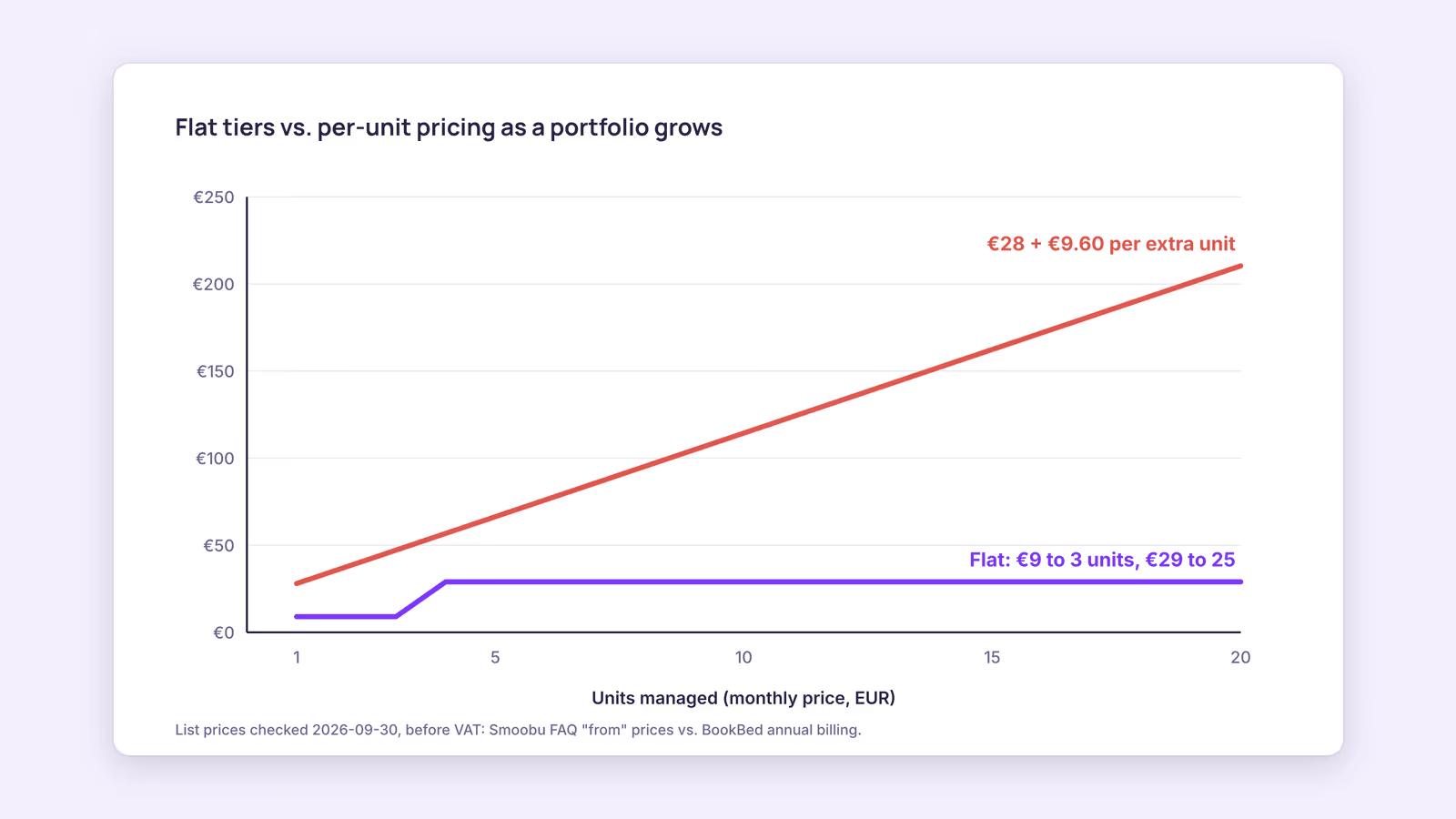
You're comparing tools and the prices don't line up. One vendor quotes per property, another per booked night, a third has a free plan, and a fourth charges one flat fee for a band of units. Property management software pricing for vacation rentals is built on a few different models, and the cheapest one at three units can be the most expensive at twenty.
Start with two numbers before you open any pricing page: how many units you run today, and how many you expect to run in 12 months. Price every tool on your shortlist at both counts. A tool that only looks good at today's count is a tool you may have to leave next year.
How is property management software pricing structured?
Most vacation rental PMS tools use one of four models: flat fees per band of units, per-unit prices, per-booking or per-night fees, or a free core plan with paid add-ons.
Here's how each works, with examples as the vendors publish them on their own pricing pages.
1. Flat tiers by unit band. You pay one price for a range of units, and the bill only moves when you cross into the next band. BookBed works this way: Starter is €9/month on annual billing for up to 3 units, and Pro is €29/month on annual billing for up to 25 units. The trade-off: if you sit at the bottom of a band, you pay for headroom you don't use.
2. Per unit, often on a sliding scale. Each property adds to the bill, and the per-unit rate usually drops as you add more. iGMS's pricing page lists its PRO plan at $48 per property per month on monthly billing for one property, falling to $17.40 per property at 10 and $14.20 at 20. OwnerRez describes "per-property pricing" on a sliding scale, with premium features priced on top. A related variant is a base price plus a charge per extra unit: Smoobu says a single unit starts "as low as €28 per month" and "each additional unit costs from €9.60 per month."
3. Per booking or per booked night. The fee tracks usage instead of unit count. iGMS's FLEX plan charges $1 per booked night with a minimum of $20 per property per month. Smoobu's Professional Flex plan is €29/month plus a 0.9% fee per booking; its other plans are commission-free.
4. Free core plan with paid tiers and add-ons. Hospitable lists a free Essentials plan with a unified inbox, automated messaging and Airbnb, Vrbo, Booking.com and Agoda sync. Paid tiers add features such as a direct booking website and owner statements, and its comparison table shows a charge per extra property on the paid tiers ($10 on Host, $15 on Professional and Mogul) once you pass the properties included in the base price. Guesty sits between models 2 and 4: price depends on listings and add-ons, with "packages that start from $9/month per listing."
What does a PMS software price look like at 3, 10 and 20 units?
The same pricing model can look cheap or expensive depending on portfolio size, so the only fair property management software price comparison is the monthly total at your own unit count.
The table below uses list prices from each vendor's page, checked on 2026-09-30, before VAT. Currencies differ, so compare the shape of each row rather than converting.
| Model and example | 3 units | 10 units | 20 units |
|---|---|---|---|
| Flat tiers: BookBed, annual billing | €9 | €29 | €29 |
| Flat tiers: BookBed, monthly billing | €12 | €39 | €39 |
| Per unit, sliding scale: iGMS PRO, monthly billing | $69.99 | $174.00 | $284.00 |
| Base plus per unit: Smoobu, "from" prices in its FAQ | from €47.20 | from €114.40 | from €210.40 |
| Per booked night: iGMS FLEX | at least $60 | at least $200 | at least $400 |
How to read it:
- Flat tiers barely move with growth until you hit the band limit. Above 25 units, BookBed's Agency plan is custom-priced, so the flat line stops there.
- Per-unit pricing grows with every property, even when the per-unit rate falls. The iGMS row is its per-property rate multiplied by the unit count.
- Base plus per unit is the Smoobu FAQ's starting price plus €9.60 for each extra unit. Treat it as a floor: the real figure depends on plan and billing period, and Smoobu quotes individually above 20 properties.
- Per booked night is the minimum only. Consider a hypothetical unit booked 26 nights in a month: at $1 per booked night that unit costs $26, not $20. A seasonal rental with empty winter months pays the minimum, not zero.
This doesn't show features. A cheaper row may exclude the one thing you need, so match each tool against the features on your list first, then compare cost. Our guide to choosing a vacation rental PMS covers that shortlist step.
Which hidden costs don't show up on the headline price?
The biggest hidden costs are platform fee changes, per-booking percentages, paid add-ons, extra user seats, payment processing and notice periods. None of them appear in the headline monthly number.
Use this checklist on every tool you're considering:
- Your Airbnb fee structure. Airbnb's service fee article says the single fee, where the whole fee comes out of your payout (15.5% for most hosts), is mandatory for "hosts who use property management software." Under the older split fee, most hosts pay 3% and guests pay a separate service fee. Once you've switched, "you can't switch back." Airbnb is moving all hosts to the single fee anyway, which suggests software mainly changes the timing. Airbnb's article doesn't say exactly which tools count, so check the fee line on your first payout after connecting any software. Since guests no longer pay a separate fee, review your nightly prices; host-only vs split fee walks through the math.
- Per-booking percentages. Look for booking fees (Smoobu Flex: 0.9%) and processing fees on extras. Hospitable's table lists a 10% processing fee on custom upsells on Essentials and 7% on paid plans, and dynamic pricing on Essentials is free for 3 bookings in the first 30 days, then $5 per property.
- Premium features and add-ons. OwnerRez prices property management, QuickBooks, hosted websites, SMS and its AI assistant as premium features, and says SMS usage fees apply after 500 outbound message segments. Guesty prices add-ons separately.
- Extra users. Smoobu says additional write-access accounts cost from €12 per month.
- Payment processing on direct bookings. Card fees are separate from the software fee. Stripe's Ireland pricing lists 1.5% + €0.25 for standard EEA cards, 2.8% + €0.25 for premium EEA cards and 3.15% + €0.25 for international cards.
- Notice periods and billing terms. Smoobu requires 30 days' notice, with cancellation taking effect at the next renewal. Annual billing is cheaper (Smoobu offers 10% off yearly and 20% off two-year plans; Hospitable says annual saves 12%), but it also commits you for longer.
Put it together with one formula:
Yearly cost = subscription at your unit count × 12 + per-booking fees + add-ons + extra seats + card processing on direct bookings
Then add the one-off cost of moving later. If you might outgrow a tool, read how to switch vacation rental PMS before you commit to an annual plan.
When this advice does not apply
- Larger portfolios. Several vendors quote big portfolios individually: BookBed above 25 units, Smoobu above 20 properties and Guesty at 200+ listings. Published list prices stop being useful; negotiate on the full contract.
- Long-term rental software. Some tools sold as property management software are built for tenants, leases and rent collection. Their pricing works differently, and this comparison doesn't cover them.
- You only need calendar sync. If you run one or two units on two platforms, a channel manager may cover the whole job, and a full PMS price comparison is premature.
- Prices change. Every figure here was checked on 2026-09-30. Recheck each vendor's page before you buy.
What to do next
- Write down your unit count today and in 12 months, and the three features you can't work without.
- Price each shortlisted tool at both counts from its own pricing page, on the billing period you'd actually choose.
- Run the hidden-cost checklist above and add every per-booking fee, add-on and seat to the yearly total.
- Check your Airbnb fee structure in your earnings before connecting any software, then again on the first payout after.
- Use the free trial to confirm the features you're paying for work with your channels.
FAQ
How much does vacation rental software for small business cost?
For 1 to 3 units, published prices in this comparison run from free (Hospitable Essentials) to about €9–€12 a month (BookBed Starter) to around $70 a month (iGMS PRO at 3 units, monthly billing). Add-ons, booking fees and card processing come on top.
Is there an average cost of property management software?
Not one you can rely on. Pricing depends on unit count, billing period, model and add-ons, and vendors don't publish comparable averages. Price your own portfolio instead.
Is per-booking pricing cheaper for a seasonal rental?
It can be in slow months, but check the minimums. iGMS FLEX charges at least $20 per property per month even with no bookings, and a percentage fee grows as your nightly rates rise.
Flat pricing by unit band. BookBed Pro covers up to 25 units for €29/month on annual billing, with 0% commission on your bookings, so adding a unit inside the band doesn't raise your bill. See BookBed pricing
Sources
- Airbnb, "Airbnb service fees" — Verified 2026-09-30
- iGMS, "iGMS Pricing: Flexible Plans for Hosts and Managers" — Verified 2026-09-30
- Smoobu, "Smoobu vacation rental software pricing plans" — Verified 2026-09-30
- Hospitable, "Hospitable Pricing | Vacation Rental Software Plans" — Verified 2026-09-30
- Stripe, "Pricing & fees" (Ireland) — Verified 2026-09-30