You've listed your place on Airbnb, someone suggests adding Booking.com, and every host forum says the same thing: "get a channel manager." So what is a channel manager, and what does the label actually promise? In plain terms, the channel manager meaning is simple: one tool that holds your availability and passes it to every platform where you list, so a booking on one site closes those nights on the others.
The label hides a big difference, though. Some channel managers exchange calendar files with Airbnb and Booking.com. Others connect through each platform's partner API. Both get called "channel managers," and they don't behave the same way.
Your first action today: open the calendar or sync settings of any tool you're considering, or already use, and write down how it connects to each platform. If you see calendar links ending in .ics, it's iCal-based for that platform. If you connected through your Airbnb account or picked the tool inside Booking.com's extranet, it's likely an API connection.
What is a channel manager, in plain terms?
A channel manager is software that keeps one master record of which nights are open for each unit and shares it with every booking platform, or "channel," so dates booked in one place close everywhere else.
Without one, you're the channel manager. Every time a booking lands on Airbnb, you log in to Booking.com and block the same nights, and vice versa. That works with one listing and a slow calendar. It breaks when you're asleep, traveling, or managing several units, because the platforms don't talk to each other on their own unless you connect them.
A channel manager for short-term rentals usually covers:
- Availability: closing nights on every channel after a booking.
- A single calendar view: all bookings per unit in one place.
- Sometimes more: rates, minimum stays, reservation details and guest messages, but only when the connection type supports it.
That last point is where tools differ most, and it depends on how the tool connects.
How does a channel manager connect to Airbnb and Booking.com?
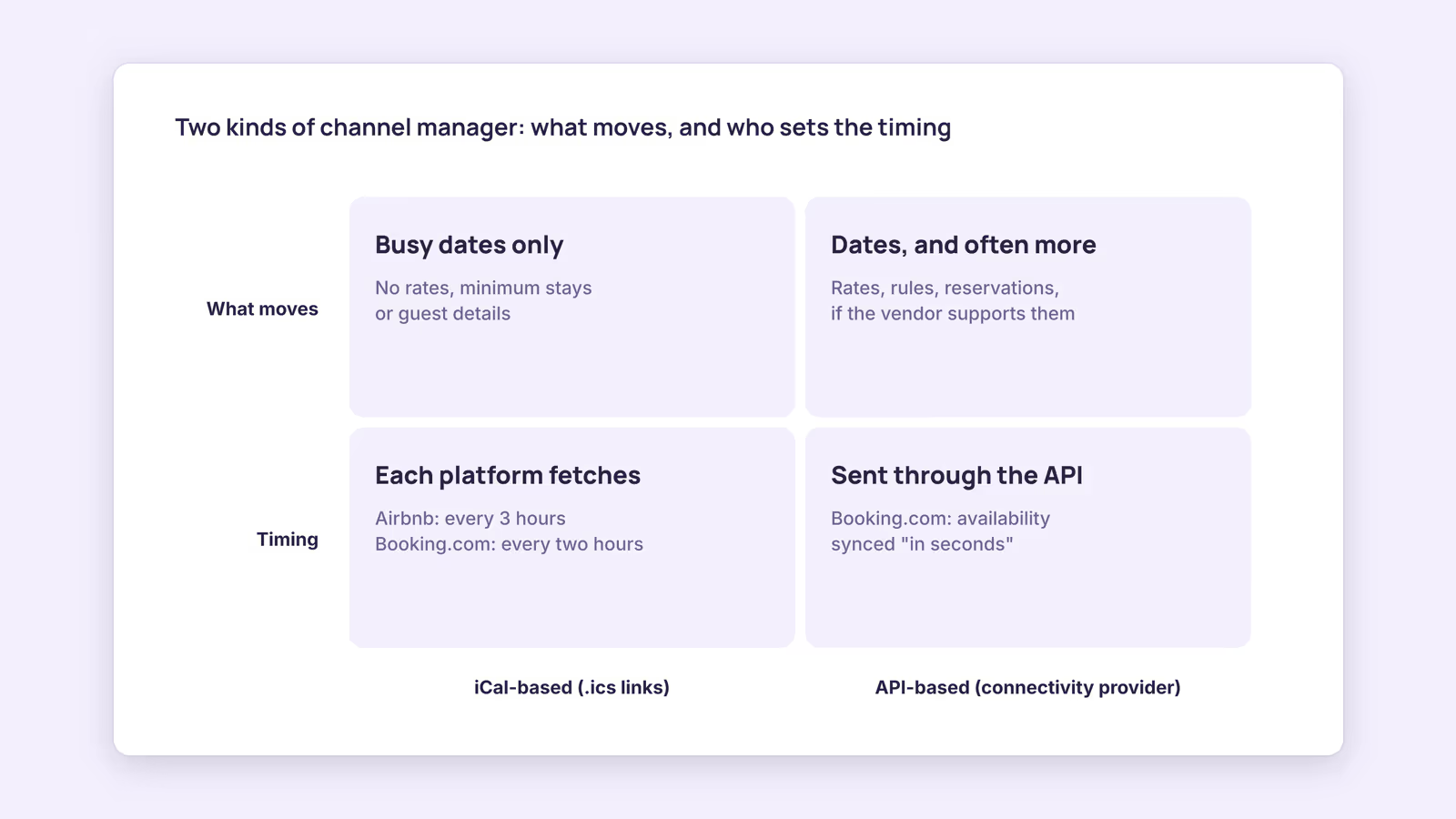
Channel managers connect in one of two ways: by exchanging iCal calendar files that each platform fetches on its own schedule, or through a platform's partner API, which Booking.com calls a "connectivity provider" connection.
iCal-based channel managers use the iCalendar format defined in RFC 5545. Each platform publishes a private .ics link listing booked dates, and the channel manager imports those links and publishes its own. The receiving side decides when to fetch. Airbnb says your calendar "automatically updates every 3 hours" from connected calendars. Booking.com's calendar sync article says it "automatically imports any connected calendar every two hours" and that sync "is not in real time." No tool on the other end of the link can change those schedules. iCal also carries dates only, not prices, minimum stays or guest details.
API-based channel managers are software companies approved to use a platform's partner interface. Booking.com's Connectivity Portal describes a Rates & Availability API to "sync availability in seconds and manage rates," says it doesn't accept direct connections from individual properties, and tells property owners to connect via a channel manager instead. The same page currently says Booking.com is pausing integrations with new connectivity providers. Airbnb's API documentation lists partner functions for managing listings, availability checks and reservations. What an API-based tool actually syncs depends on what that vendor built, so read its feature list per platform.
Here's what typically moves through each connection type:
| What you need synced | iCal-based connection | API-based connection |
|---|---|---|
| Booked and blocked dates | Yes, on the receiving platform's fetch schedule | Yes, sent through the platform's API |
| Nightly rates | No | Often, if the vendor supports it |
| Minimum stays and other rules | No | Often, if the vendor supports it |
| Guest name and reservation details | No, only a date block | Often, if the vendor supports it |
| Setup | Copy and paste links | Connect the tool through the platform account |
One constraint to know before you choose: Booking.com's calendar sync article lists eligibility rules. Your property needs 20 room types or fewer, a maximum of one unit per room type, and you can't already be using a connectivity provider. So on Booking.com, the two approaches are mutually exclusive for a property. For the delay side of this trade-off in more depth, see iCal vs API sync.
How can you tell which kind of channel manager you're looking at?
Ask how the tool connects to each specific platform, because many vendors use API connections for some channels and iCal for others, and marketing pages often say "sync" without naming the method.
Use these five questions with any vendor, or check them yourself during a free trial:
| Question | Answer that points to iCal | Answer that points to API |
|---|---|---|
| How do I connect my Airbnb listing? | Paste an .ics link into each side | Connect through your Airbnb account, not a link |
| How do I connect Booking.com? | Paste links in the extranet's Sync calendars page | Select the provider in the extranet's channel manager settings |
| Can I change my Booking.com price from the tool? | No, change it in the extranet | Yes, if rates are supported |
| Does a new booking arrive with the guest's name? | No, it shows as a blocked date | Yes, if reservations are supported |
| Who decides when Airbnb picks up a change? | Airbnb's fetch schedule | The tool's connection to the platform |
Our recommendation: get the answers per platform in writing before you migrate listings. A tool can be API-connected to one site and iCal-connected to another, and your double-booking exposure is set by the slowest link.
If you already run an iCal setup, paste each export link into the iCal checker to confirm the feeds are reachable and well formed.
What does a channel manager leave for you to handle?
A channel manager closes dates across platforms, but it doesn't bring guests, write your listing, set a pricing strategy, or remove the gap between a booking and the next calendar fetch on an iCal link.
A few jobs stay with you whichever type you pick:
- Timing gaps on iCal links. Consider a hypothetical host whose apartment gets booked on Airbnb at 10:00. On an iCal link, Booking.com only sees it after its next import, which can be up to two hours later by Booking.com's own description. In busy weeks, block nights by hand as soon as a booking lands. The double-booking prevention guide covers manual blocks and buffer nights.
- Everything outside the calendar. Cleaning schedules, invoices, payments and guest messages usually live in a property management system (PMS). Many products bundle both, which is why the terms blur. See channel manager vs PMS for where the line sits.
- Platform rules. Cancellation policies, fees and review responses are still set on each platform.
This suggests a simple way to size your need: if you only list on one platform, you may not need a channel manager yet. Once the same unit is bookable in two places, something has to keep the calendars in step, whether that's you or software.
When this advice does not apply
- Hotel-style inventory: if you sell several identical units under one Booking.com room type, or more than 20 room types, Booking.com's calendar sync isn't available to you, and you'll need a connectivity provider.
- Platforms beyond Airbnb and Booking.com: Vrbo and smaller sites set their own sync rules. Check each platform's help pages.
- Vendor-specific behavior: API connections vary by vendor and platform. Confirm what's synced in the tool's documentation, not in this general description.
What to do next
- List every platform each unit is on, and how each connects today: manual, iCal link, or API.
- Ask the five vendor questions for each platform you use, and get the answers per platform.
- Decide what you need synced: dates only, or also rates, rules and reservation details.
- Test any iCal feeds with the iCal checker mentioned above before you connect them to a new tool.
- During a trial, block a far-future night on one platform and time how long it takes to close elsewhere.
FAQ
What is a channel manager for Airbnb?
It's a tool that connects your Airbnb listing to your other channels. It either imports and exports Airbnb calendar links, or connects through Airbnb's partner API, depending on the vendor. Airbnb lists its approved software partners on its own site.
What is a channel manager on Booking.com?
In the extranet, a channel manager connected by API appears as a "connectivity provider." If you use one, Booking.com's calendar sync with .ics links isn't available for that property, according to its eligibility rules.
Is a PMS the same as a channel manager?
No. A channel manager keeps availability consistent across platforms. A PMS runs the rest of the operation, such as reservations, messaging and invoicing. Many products include both, so check which parts a given plan covers.
About BookBed: BookBed is an iCal-based channel manager, not an API-connected one. Its two-way iCal sync with Airbnb and Booking.com gives each unit one calendar where every import and export link lives, so you can see and audit the whole setup in one place. Airbnb and Booking.com still fetch on their own schedules, so manual blocks still matter in peak weeks. See BookBed pricing
Sources
- IETF, "RFC 5545: Internet Calendaring and Scheduling Core Object Specification (iCalendar)" — Verified 2026-09-30
- Airbnb Help Center, "Sync your home host calendar to other websites" — Verified 2026-09-30
- Booking.com for Partners, "Updating your availability calendar in the extranet" — Verified 2026-09-30
- Booking.com, "Booking.com Connectivity Portal" — Verified 2026-09-30
- Airbnb, "Airbnb API Documentation" — Verified 2026-09-30