Your property website probably has a home page, a page per unit, photos and a booking form. That covers travelers who already know your place exists. It does nothing for the larger group still deciding where to stay, who search questions like "can you reach the beach without a car" or "where do you park near the old town in August". If your site never answers those questions, those people never reach it.
A local area guide fixes that gap when it does one specific job: it answers a question travelers ask before they book, using what you know first-hand, and then points the readers whose trip fits your rental to the unit that fits. Start by writing down the last ten questions guests asked you before they booked. Those are your raw material.
What makes a local guide bring qualified visitors?
A qualified visitor is someone whose trip matches what your rental offers: the right area, season, group size and way of getting around. A good guide attracts those people and helps the others rule your place out.
A guide that says "the nearest supermarket is a 25-minute drive, so plan a big shop on arrival" will put off some readers. The ones who stay are people for whom that trade-off works.
Google's guidance on creating helpful, people-first content asks whether a page provides "original information, reporting, research, or analysis" and whether it offers "substantial value when compared to other pages in search results." A host has an advantage here that a travel site rarely has: you know which parking area fills by 10 a.m., which beach path is steep, and what is still open in November. Google does not say that first-hand detail guarantees a ranking. We infer that it is the part of the page other sites cannot copy, so it is where your effort should go.
Which questions should the guide answer?
Answer the questions people ask while choosing where to stay, and keep everything a guest needs only after booking in a private welcome guide.
Your inbox is the best source: messages from people who had not booked yet, and questions guests raised mid-stay that would have affected their choice. Typical pre-booking questions cover getting there, getting around without a car, parking, distances to the things the area is known for, what changes by season, and whether the area suits children, older travelers or people who work remotely.
Some information belongs on the public page and some does not:
| Information | Public guide | Private welcome guide |
|---|---|---|
| How to reach the area by car, train or ferry | Yes | Repeat briefly |
| Walking distance to beach or town, as you measured it | Yes | No |
| Seasonal closures and busy periods | Yes | No |
| Parking rules near the property | General area rules | Exact space and permit details |
| Door codes, lockbox, Wi-Fi password | Never | Yes |
| Your exact address or unit number | Avoid | Yes |
| Restaurant and shop picks | Yes, with reasons | Yes, with booking tips |
For the messages that carry private details once a guest has booked, see our welcome message templates. The rule for the public page is simple: if publishing it would help a stranger find or enter your property, leave it out.
What should the guide page include?
One page should answer one main question, show how you know the answer, say when it does not hold, and link to the specific unit that suits a reader with that question.
Use this outline for each guide page:
- A title that is the question. For example, "Getting to [town] without a car". The SEO Starter Guide describes a good title as unique to the page, clear and concise, and accurate about the contents.
- A direct answer in the first two sentences. Say yes, no or "it depends on", and name what it depends on.
- The specifics you checked yourself. Distances, walking times, which bus stop, which car park. Say how you measured: "a 12-minute walk at an easy pace, mostly downhill on the way there" tells a reader more than "close to the beach".
- What changes by season. Timetables, closures, crowds, weather limits.
- Who this does not suit. One honest sentence saves you a mismatched booking.
- A link to the unit that fits. Use link text that names the unit and why it fits, such as "the ground-floor apartment with its own parking space". Google's starter guide says link text should help people understand what the linked page contains.
- Sources and a last-checked date. Link to the ferry operator, the park authority or the town's parking page, and state the month you last checked.
If you cannot say anything specific under point 3, the page is not ready to publish.
How do you keep a local guide accurate?
Record a source and a recheck date for every fact that can change, and recheck before each season instead of rewriting the whole page.
Local facts go out of date: timetables change, restaurants close, parking becomes paid. The SEO Starter Guide advises checking previously published content and updating it as needed, or deleting it if it is no longer relevant. Google's helpful content page also warns against changing page dates to look fresh without a substantial update, so change the last-checked date only after you have actually checked.
Keep a simple update log for each guide page:
| Fact type | Where to check | When to recheck |
|---|---|---|
| Ferry, train or bus timetable | The operator's own website | Before each season |
| Parking zones and charges | Town or city website | Each spring |
| Beach, trail or park rules | The managing authority | Before peak season |
| Opening hours of places you recommend | Their website or a phone call | Twice a year |
| Annual events and dates | The organizer's site | Once the new dates are announced |
| Your own measured distances | Walk or drive it again | When a route changes |
If you recommend businesses because they pay you a commission, say so on the page. The US Federal Trade Commission's answers on endorsements say an affiliate relationship should be disclosed clearly and conspicuously, and that the closer the disclosure sits to the recommendation, the better. A recommendation you make with no payment or other benefit from the business does not raise that issue.
What should a host avoid when building area pages?
Avoid publishing many near-identical pages aimed at nearby towns or keyword variations. Google's spam policies name this pattern directly.
Google's spam policies describe doorway abuse as pages "created to rank for specific, similar search queries," and give the example of pages "targeted at specific regions or cities that funnel users to one page." Ten pages titled "Rentals near [village]", each with two paragraphs and a booking link, match that description. The same policies also cover scaled content abuse: many pages produced mainly to manipulate rankings that add little value for readers, however they were created.
Add a second page only when you have a second question with its own first-hand answer.
How do you connect the guide to your booking page?
Link from the paragraph where a reader realizes your rental suits them, to the page where they can check dates and book that unit.
A reader who has just learned that the old town is a flat walk from your apartment should not have to return to your home page to find availability. Link to the unit page, which then has to show the dates that are actually free and the full price. Our booking page checklist covers what a first-time direct guest needs to see there.
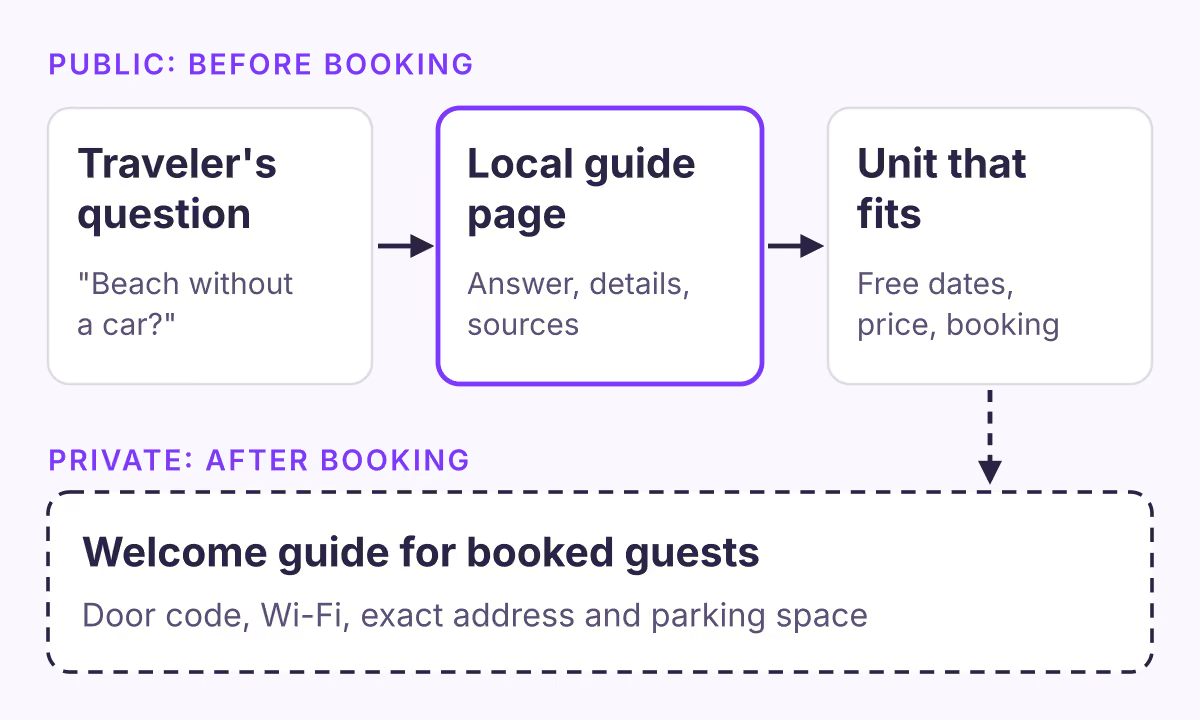
The diagram shows the path a guide page should create. It does not show how many readers take each step: that depends on your area, your pages and your prices.
A guide page does not create demand. It gives people already searching about your area a reason to land on your site; whether they book still depends on your dates, price, reviews and booking step. For other ways to bring visitors, see our guide to getting traffic to a direct booking site.
How do you know whether a guide page is working?
Check the page in Google Search Console after several weeks, looking at the queries it appears for and whether readers move on to a unit page.
In the Search Console Performance report, filter the report to the guide page's URL, then look at the Queries tab. Impressions are the number of times your site appeared in results for those searches; clicks are visits from Google. Queries unrelated to your page's question suggest it is being found for something you did not intend.
Give it time. The SEO Starter Guide says some changes take effect in a few hours and others could take several months, and suggests waiting a few weeks before judging a change. On a small site, single-digit counts are normal, so treat early numbers as signals, not proof. Your website analytics can show whether visitors moved on from the guide to a unit page; do not expect a clean line from one page to one reservation.
For the wider search picture, including ranking for your property's own name, see our guide to direct booking SEO for vacation rentals.
When this advice does not apply
- Your site has no working booking path. Fix the unit page and booking step first. Traffic to a page nobody can book from does not help.
- You cannot write from knowledge. If you live far away and have not visited recently, a guide rewritten from other websites adds little and may be wrong. Collect details on your next visit or from someone local you trust, and credit them.
- Local rules affect what you publish. Some places require a registration or permit number on rental advertising. Check what applies to you; that is a legal question, not a content one.
What to do next
- List the questions people asked you before booking in the past year and group the repeats.
- Pick the one question you can answer best from first-hand experience.
- Draft one page using the seven-part outline, with your own measurements and a "who this does not suit" line.
- Link it to the specific unit page that fits, and start an update log with sources and recheck dates.
- Check Search Console for that page after several weeks before writing the next one.
Sources
- Google Search Central, "Creating helpful, reliable, people-first content". Verified 2026-11-01.
- Google Search Central, "Spam policies for Google web search". Verified 2026-11-01.
- Google Search Central, "SEO Starter Guide". Verified 2026-11-01.
- Google Search Console Help, "Performance report (Search results)". Verified 2026-11-01.
- US Federal Trade Commission, "FTC's Endorsement Guides: What People Are Asking". Verified 2026-11-01.
About BookBed: BookBed's embeddable booking widget shows a unit's availability and takes direct reservations on your own website, so a reader who arrives from your local guide can check dates on the unit page. It does not bring visitors to your site or make them book. Get the direct booking widget