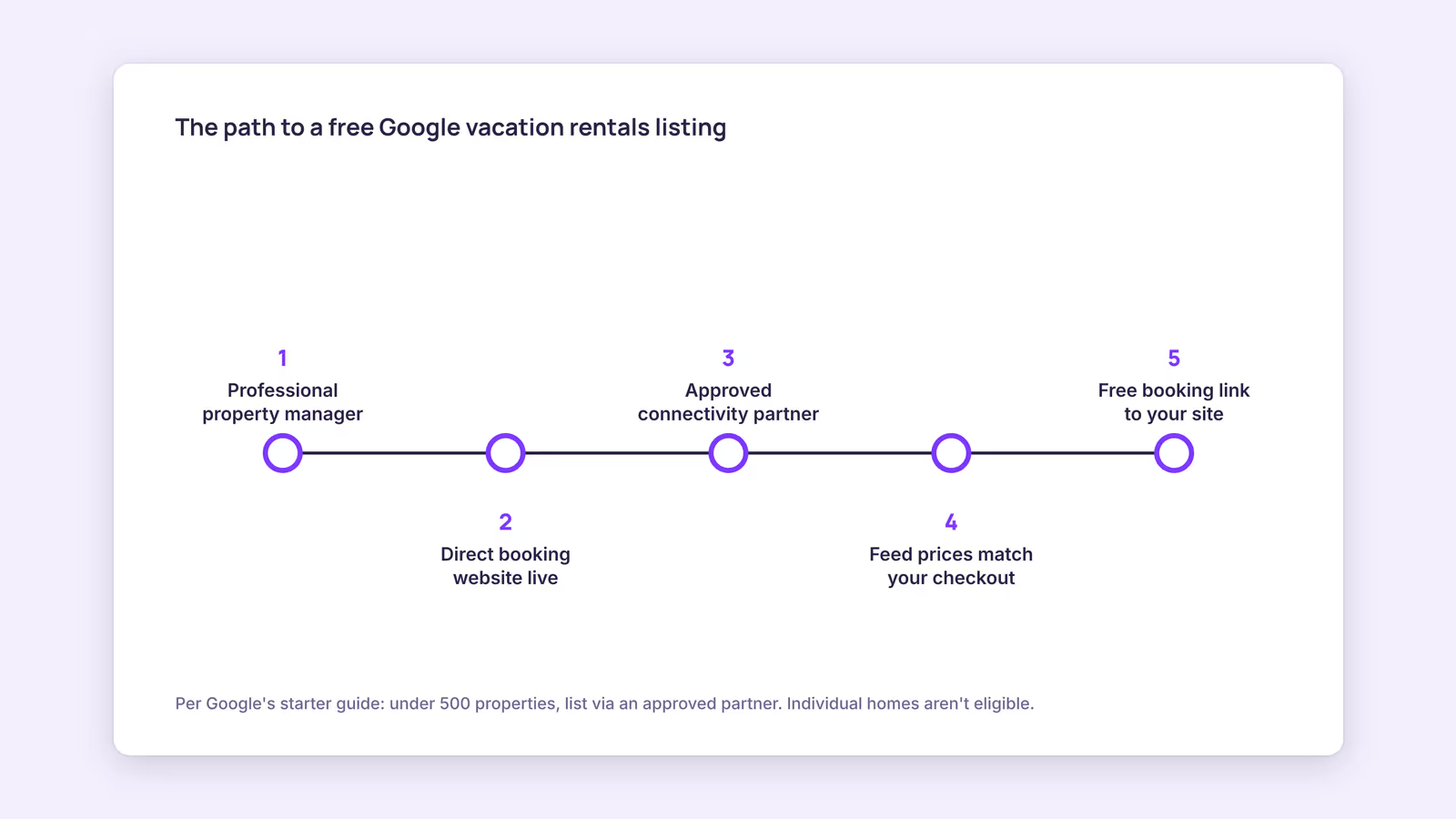
You've seen rental listings with prices sitting right inside Google Search and Maps, and you want your place there too, pointing at your own booking site instead of an OTA. Google vacation rentals can do that, and Google charges nothing for the clicks. The catch is eligibility: Google lists professionally managed inventory, not individual homes, and most managers get in through an approved software partner.
Your first action: before you touch any settings, answer the three eligibility questions below. If any answer is "no," the listing route is closed for now, and your time is better spent elsewhere.
What is Google vacation rentals, and how does it work?
Google vacation rentals is a free listing surface where approved partners send rates, availability and content, and Google shows those rentals in Search, Maps and Google Travel with a link to book on the partner's site.
Google's Hotel Center help describes it plainly: partners share rates, availability, photos and descriptions, listings appear alongside organic results, and free booking links "redirect users to book directly on your website." Google states there are no fees for Google-generated referrals or bookings.
So Google doesn't take the booking or the payment. Whoever sent the listing owns the landing page. If an OTA sent it, the click goes to the OTA. If you sent it through your own feed, the click goes to your site, and your normal payment processing costs still apply.
Who can list on Google vacation rentals?
Only professional property managers with a suitable direct booking website qualify; Google says individual homeowners and individual or subleased homes aren't considered businesses for its vacation rentals results.
That line comes from Google's starter guide for property managers, which defines a property manager as a business contracted, authorized or licensed by owners to market and manage bookings, acting as merchant of record. The same guide sets two paths:
- Fewer than 500 properties: Google "strongly" recommends connecting through an approved connectivity provider. You need a direct booking website and the ability to give that provider pricing and availability.
- At least 500 properties: you may qualify for direct integration, with a designated technical contact. Google says this typically takes 8 to 12 weeks after it receives your property list.
A Google Business Profile isn't a shortcut either. Google's eligibility guidelines list vacation homes among ineligible businesses. For more on that route, see our guide to Google Business Profile for vacation rentals.
Eligibility check before you spend any time
| Question | If yes | If no |
|---|---|---|
| Are you a business managing rentals on owners' behalf (or your own portfolio as a company)? | Continue | Not eligible today; focus on OTAs and your own site |
| Do you have a direct booking website that takes bookings with live prices? | Continue | Build that first; there's nothing to link to |
| Does your software appear on Google's partner list? | Ask them to switch the feed on | Ask them to apply via Google's interest form, or consider a listed partner |
How to list on Google vacation rentals through connectivity partners
For most managers, the practical route is to use software from Google vacation rentals connectivity partners, which send your listings, prices and availability to Google on your behalf.
Google publishes a list of approved vacation rentals partners. If yours isn't on it, Google points you, or your provider, to its vacation rentals interest form. Here's the sequence we'd follow.
- Confirm your provider is on Google's list. Check the list directly rather than relying on a sales page.
- Clean your property data. Google's developer onboarding guide lists the static details a listing needs: name, address, geocode location, images, website URLs and amenities.
- Make prices on your site match the feed. The same guide says price and availability must match your website to keep a good Price Accuracy Score. A feed that quotes one total and a checkout that shows another is a problem.
- Check the landing page. Google sends travelers to a page with the itinerary prefilled. Test that the dates and guest count carry through to your checkout.
- Watch performance. Hotel Center offers performance reports for booking links, so you can see whether clicks become bookings.
Our recommendation: treat step 3 as the one that fails most quietly. Cleaning fees, taxes or extra-guest charges that appear only at checkout are exactly the kind of mismatch that can hurt price accuracy.
Is Google vacation rentals worth it for hosts?
It's worth pursuing if you already qualify and already run a working booking site; if you're an individual host, the route isn't open, so your effort belongs on OTA listings and repeat guests.
Compare it with an OTA listing rather than treating it as a replacement. Consider a hypothetical manager with a €1,200 week booked either way.
| Route | Who takes payment | Channel fee on €1,200 | What you still pay |
|---|---|---|---|
| Google free booking link to your site | You | €0 from Google | Card processing, e.g. 1.5% + €0.25 on a standard EEA card via Stripe (€18.25) |
| Airbnb, single-fee model | Airbnb | Host fee, 15.5% for most hosts per Airbnb (€186) | Nothing further for processing |
This suggests the saving per booking is real, but it only exists if Google actually sends clicks and your site converts them. Google doesn't promise volume, and a listing isn't the same as ranking. On Google vacation rentals vs Airbnb more broadly: Airbnb brings its own demand, reviews and guest trust, while Google sends traffic to a site you must make convincing. Most managers who qualify run both. Our direct booking vs OTA math walks through the full cost comparison.
When this advice does not apply
- Individual owners with one or two homes: Google's guide excludes individual homes, so the listing steps above won't apply until you operate as a professional manager.
- Hotels and aparthotels: Google routes hotel-category properties through its hotel products, not vacation rentals, and may decline to serve them in a rental feed.
- Large portfolios: at 500 or more properties, direct integration has its own contract and technical requirements beyond this guide.
What to do next
- Run the three-question eligibility check above and write down each answer.
- Look up your software provider on Google's partner list.
- Compare the total price on your booking site with what you'd send in a feed, including every fee.
- If you don't have a direct booking site yet, start with our guide on how to build a direct booking website.
- Re-check Google's partner list and eligibility page every few months, since both change.
FAQ
Does Google charge a commission for vacation rental bookings?
No. Google says its free booking links carry no fees for Google-generated referrals or bookings. You still pay your own payment processor and any software subscription.
Can I list my property on Google vacation rentals myself?
Not as an individual homeowner, and there's no self-serve form for single homes. Professional managers with fewer than 500 properties usually list through an approved connectivity partner.
Do my Booking.com or Vrbo listings already appear on Google?
They may, if those companies are Google partners, but the booking link then goes to their site, not yours. Check how your listing appears in Google Travel to see which link travelers get.
About BookBed: BookBed isn't on Google's vacation rentals partner list, so it can't publish your listings to Google. What it does give you is the piece Google's path requires first: an embeddable direct booking widget with Stripe checkout, paid into your own Stripe account with 0% commission. See BookBed plans
Sources
- Google Hotel Center Help, "About vacation rentals on Google" — Verified 2026-09-30
- Google Hotel Center Help, "VR property managers: Starter guide overview" — Verified 2026-09-30
- Google Hotel Center Help, "Google's vacation rentals partners" — Verified 2026-09-30
- Google for Developers, "Vacation Rentals onboarding" — Verified 2026-09-30
- Google Business Profile Help, "Business eligibility and ownership guidelines" — Verified 2026-09-30