You're paying a platform fee on every OTA stay and wondering how much of it you'd keep if some guests booked with you instead. The honest answer to direct booking vs OTA isn't one percentage. It's your platform fee, minus your payment costs, minus whatever it takes to get guests to book direct.
Your first action: open your last Airbnb payout, your last Booking.com invoice or Vrbo statement, and write down the fee each one took as a share of the stay. Every calculation below works better with your real numbers than with anyone's averages.
What does each OTA take from a typical stay?
Airbnb takes 15.5% from most hosts under its single fee, Booking.com takes a contract-set commission, and Vrbo's pay-per-booking option takes 12% plus 3% payment processing. A direct booking costs mainly card processing.
Airbnb. Its service fee article says most hosts on the single fee pay 15.5%, others typically 14–16%. The older split fee (3% for most hosts, with guests paying a separate service fee) is being phased out, and hosts who use property management software must already be on the single fee. The fee applies to the nightly price plus your fees, such as cleaning, but not to taxes.
Booking.com. Its commission article describes commission as a set percentage of the total booking amount, including cleaning and similar fees. The rate depends on your country, property type and agreement, and programs like Preferred Partner add to it. In most countries it's also charged on VAT.
Vrbo. On pay-per-booking, Vrbo lists a 12% commission on rent plus host fees, and 3% payment processing on the total payment.
Direct. You pay your payment provider. Stripe's Ireland pricing page lists 1.5% + €0.25 for standard EEA cards and 2.8% + €0.25 for premium EEA cards. Other regions and card types cost more.
Direct booking vs OTA: how much more do you keep per stay?
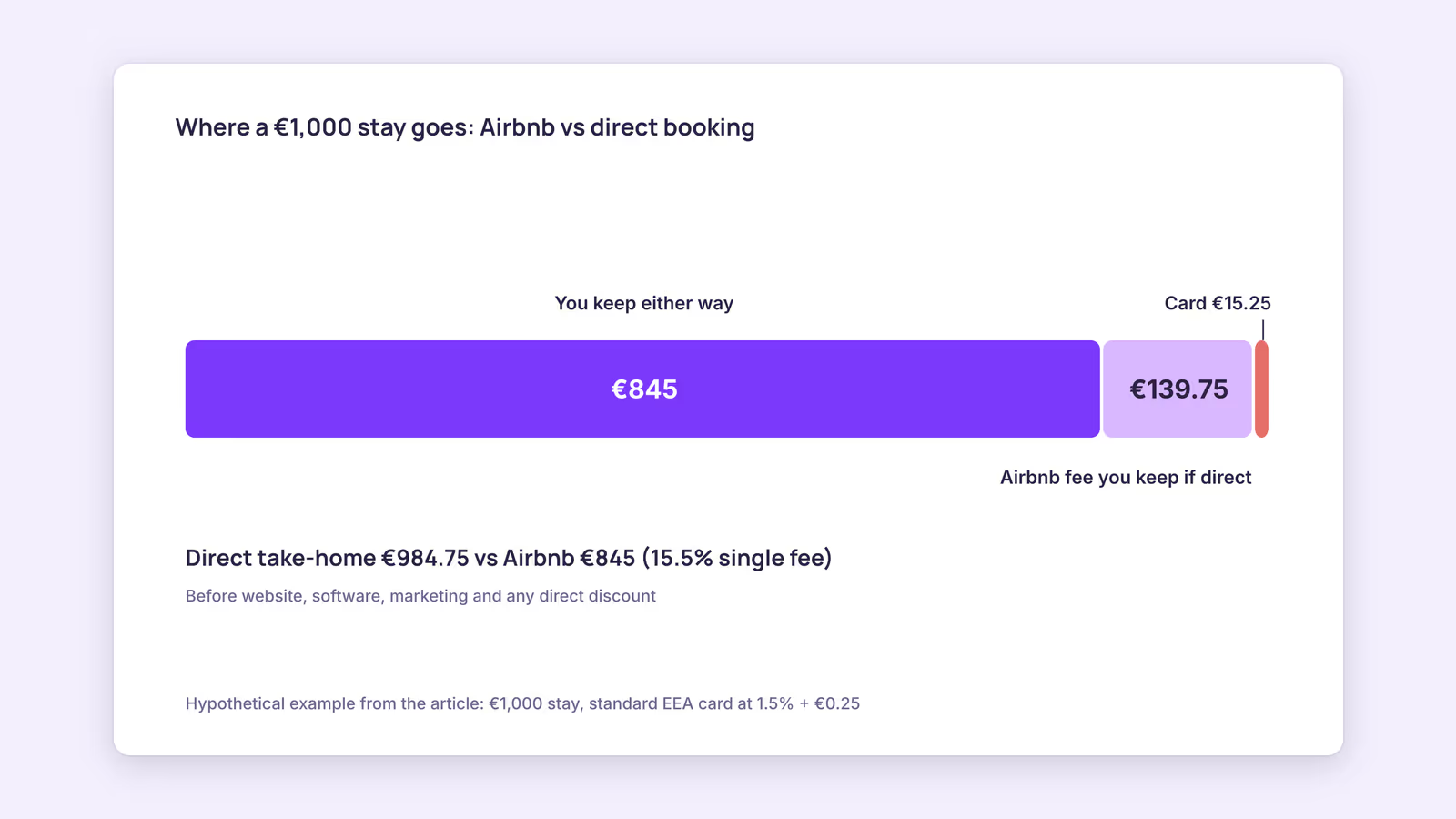
On a hypothetical €1,000 stay, you'd keep about €985 direct with a standard EEA card versus roughly €845–850 through an OTA, a gap of about €135–140 before any direct-booking costs.
Here's the worked example. Consider a hypothetical €1,000 stay (nights plus cleaning, no taxes), an Airbnb single fee of 15.5%, a Booking.com contract rate of 15% as an example, and Vrbo pay-per-booking. Swap in your own rates:
| Channel | Fee on €1,000 | Take-home before your own costs |
|---|---|---|
| Airbnb, single fee 15.5% | €155 | €845 |
| Booking.com, 15% example rate | €150 (more if VAT or programs apply) | €850 or less |
| Vrbo, 12% + 3% processing | €150 | €850 |
| Direct, standard EEA card | €15.25 | €984.75 |
| Direct, premium EEA card | €28.25 | €971.75 |
That gap is real, but it isn't profit yet. A direct booking also carries costs the OTA quietly covered: your website or booking widget, payment disputes, guest vetting, damage handling, and the marketing that brought the guest to you. The OTA fee pays for demand and a safety net, not only a checkout.
What this suggests: the per-booking gap is large, but the question that matters is how many bookings you can move, and at what cost.
Is direct booking worth it compared with Airbnb?
Direct booking is worth it when enough guests would book with you directly, usually repeat guests and referrals, that the per-booking savings cover your fixed costs and any discount you offer.
Use this formula:
Yearly gain = direct bookings × (OTA fee − card fee − direct discount) − yearly fixed costs of taking direct bookings
Consider a hypothetical host who moves eight €1,000 stays a year from Airbnb to direct, offers returning guests a 5% discount, and spends €300 a year on a website, domain and booking software:
- Guest pays €950 direct, card fee €14.50 (standard EEA), host keeps €935.50
- On Airbnb the host would have kept €845, so the gain is €90.50 per booking
- 8 × €90.50 = €724, minus €300 fixed costs = €424 a year
Change one input and the answer moves quickly. With two direct bookings a year, the same host gains €181 and loses €119 after fixed costs. Our recommendation: run the formula with the number of bookings you can realistically move, not the number you'd like to.
A quick decision check:
| Your situation | Likely answer |
|---|---|
| Few repeat guests, no website, no audience | Stay OTA-first; direct won't cover its costs yet |
| Regular repeat guests or referrals | Direct usually pays; start with a simple booking page |
| Strong local brand, social following or email list | Direct can carry a larger share of bookings |
| You rely on OTA search for almost every new guest | Keep OTAs; treat direct as a second channel |
Airbnb also sets limits on moving guests. Its off-platform policy doesn't allow you to share off-platform links, ask guests for contact details, or offer discounts to move future bookings off Airbnb. Build direct demand through your own channels, not through Airbnb messages. Our guide on how to get direct bookings covers compliant ways to do that.
Should you book direct or through Airbnb as a host's second channel?
For most hosts, the answer is both: OTAs bring new guests you couldn't reach alone, and direct bookings keep repeat guests' fees in your pocket. The risk is running two calendars that fall out of step.
If you add direct bookings, every date sold on your site must be blocked on each OTA, and vice versa. Most small setups do that through iCal feeds, which OTAs import on their own schedules, so a fresh booking can stay open elsewhere for a while. Plan for that gap in peak weeks. The iCal checker helps you confirm your feeds are valid, and why you need a direct booking website covers what the site itself should include.
To compare OTA terms side by side before you decide where to list, use the OTA fee comparison.
When this advice does not apply
- Brazil and Mexico: Airbnb publishes different host fees there.
- Hotels and multi-room properties: Booking.com commission terms and Airbnb's single-fee rules differ for hotels and serviced apartments.
- Card costs outside the EEA: Stripe fees for non-EEA, international or currency-converted payments are higher than the example above.
- Legal or tax differences: Some places tax or regulate direct short-term rentals differently. Check local rules before you take payment yourself.
What to do next
- Find the real fee each OTA took on your last three stays.
- Count repeat guests and referrals from the past year; that's your realistic direct pool.
- Run the yearly-gain formula with your fixed costs and any discount you'd offer.
- If the result is positive, set up a booking page with card checkout and connect its calendar to your OTAs.
- Review the numbers after one season and adjust your discount or marketing.
FAQ
Is OTA worth it if I already get direct bookings?
Usually yes for new guests. OTAs charge for demand you'd otherwise have to generate yourself. Keep them while they bring bookings your direct channel can't.
Can I book direct instead of Airbnb as a guest?
Guests can book with a host directly when the host runs their own site, but Airbnb doesn't allow hosts to use Airbnb to move guests off the platform.
How do Vrbo vs Airbnb vs direct booking compare on fees?
In the hypothetical €1,000 example, Airbnb's 15.5% single fee costs €155, Vrbo pay-per-booking €150, and a direct standard EEA card payment €15.25 through Stripe.
Direct booking widget: BookBed's embeddable booking widget takes reservations on your own site with Stripe checkout, paid into your own Stripe account at 0% commission. See BookBed pricing
Sources
- Airbnb Help Center, "Airbnb service fees" — Verified 2026-09-30
- Airbnb Help Center, "Off-Platform Policy" — Verified 2026-09-30
- Booking.com for Partners, "Understanding your commission" — Verified 2026-09-30
- Vrbo Help, "How is the booking fee calculated?" — Verified 2026-09-30
- Stripe, "Pricing" (Ireland) — Verified 2026-09-30