You set a nightly rate, a guest books, and the payout that lands in your account is smaller than the number you had in mind. Some of that gap is the platform's fee, some is payment processing, and some is costs you never priced in. Vacation rental fees are easy to underestimate because each channel charges them differently.
Start with one action before reading further: open your last payout statement from each channel you use and write down the fee as a percentage of what the guest paid for the stay. That number, not a figure from a blog, is what your pricing has to cover.
This guide covers the fee stack, how to find your own cost floor, and how to turn that floor into a rate for each channel.
What vacation rental fees come out of each booking?
Each booking can carry a platform fee or commission, a payment processing charge, VAT on those fees in some countries, and the taxes you collect for the government. Your own running costs then come out of what's left.
Here's how the main channels describe their host-side fees today:
| Channel | What the host pays | What it's charged on |
|---|---|---|
| Airbnb, single fee | Most hosts 15.5%, others typically 14–16% | Nightly price plus your fees, such as cleaning, not taxes |
| Airbnb, split fee (being phased out) | Most hosts 3%, guest pays 14.1–16.5% | Same base |
| Booking.com | A contract percentage that varies by country, property type and agreement | Total booking amount, including room rate and fees you charge |
| Vrbo, pay-per-booking | 12% commission plus 3% payment processing | Commission on rent and your fees; processing on the total payment, including taxes and deposits |
| Direct with Stripe (Ireland pricing) | 1.5% + €0.25 for standard EEA cards, more for premium and international cards | Each card payment |
The sources behind each row:
- Airbnb. Its service fee article says the split fee is being phased out, and the single fee is already mandatory for hosts who use property management software. The fee shown is VAT-inclusive where VAT applies. Our Airbnb host fees explainer walks through both structures.
- Booking.com. Its commission article says the percentage "depends on your country, property type and the accommodation agreement you signed." Programs like Preferred Partner or Visibility Booster add to it, and in most countries commission is charged on VAT. See Booking.com commission explained.
- Vrbo. Its booking fee article lists the 12% commission and 3% processing fee, and notes that hosts using property management software may pay 12–15% in some regions, including Europe. More in Vrbo fees explained.
- Direct. Stripe's Ireland pricing shows the card rates above. Other payment providers and countries price differently.
Notice what's missing from the table: your cleaning, laundry, utilities, software and financing. Those are the costs the rest of this guide prices in.
How do you find the lowest rate that covers your costs?
Add up a month of running costs, divide by the stays you expect to host, and you get the take-home you need from each stay before any channel takes its fee. Price below that and every booking loses money.
Here's the formula:
Take-home floor per stay = (monthly fixed costs + turnover cost × stays per month) ÷ stays per month
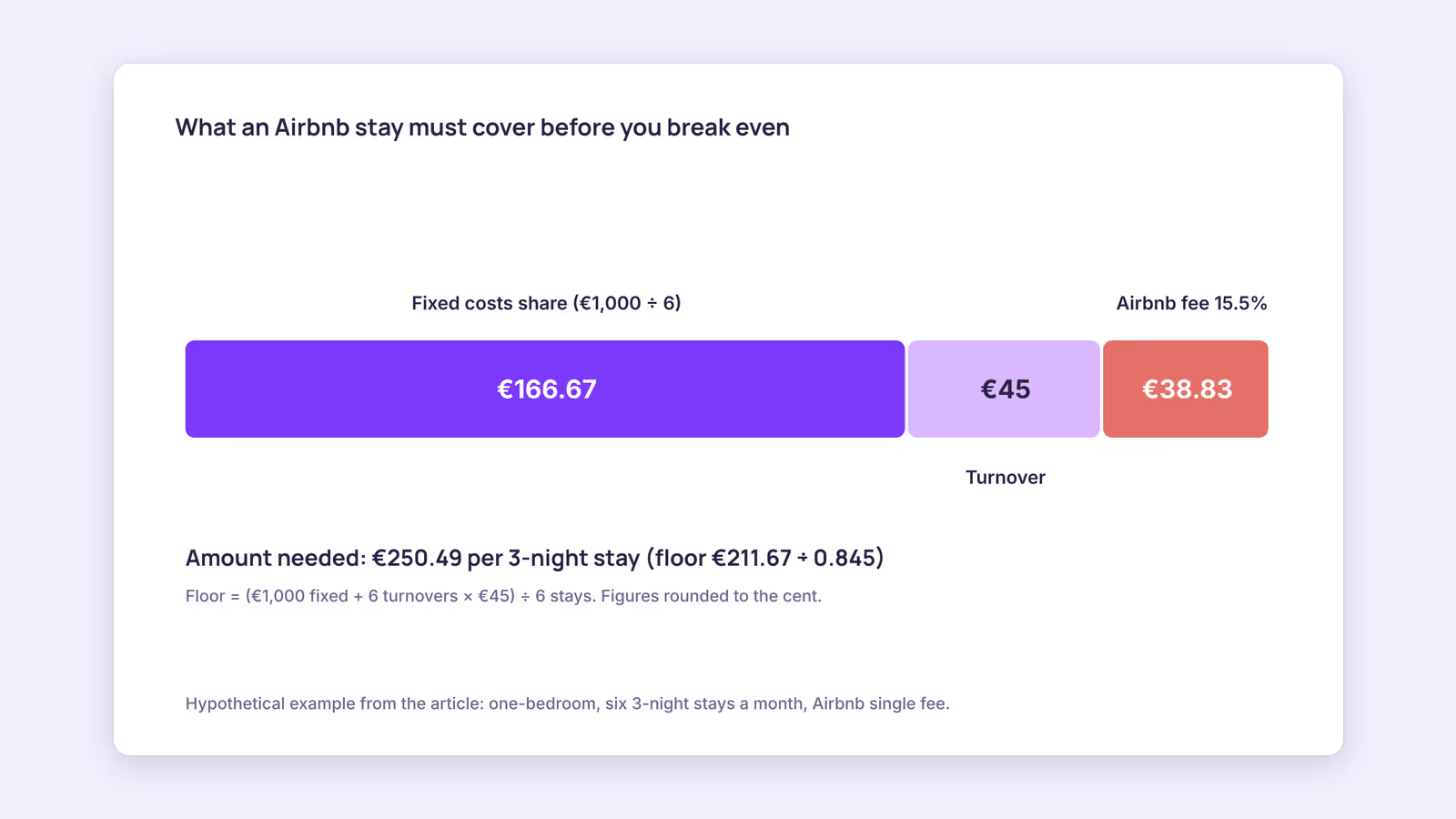
A worked example with hypothetical numbers: consider a one-bedroom apartment with €1,000 a month in fixed costs (rent or mortgage, utilities, insurance, software). You expect six stays of three nights each, so 18 booked nights. Each turnover (cleaning, laundry, consumables) costs €45.
- Turnover costs: 6 × €45 = €270
- Total monthly costs: €1,000 + €270 = €1,270
- Take-home floor per stay: €1,270 ÷ 6 = €211.67, about €70.56 per booked night
That floor is before profit. If you want a margin, add it here, not after the channel fee.
The biggest pricing factor in this formula is booked nights. If you fill 12 nights instead of 18 with the same stay length, you host four stays, and the floor per stay rises to about €295 (€1,000 plus four turnovers at €45, divided by four). Pressure-test your occupancy guess against your own booking history rather than an area average.
How do OTA fees change the rate you need on each channel?
Divide your take-home floor by one minus the channel's fee rate. The result is the amount the fee applies to, which is the nightly price plus any fees you charge, that you need to hit your floor.
Amount needed = take-home floor ÷ (1 − fee rate)
Using the €211.67 floor from the example above, with no taxes or damage deposit involved:
| Channel (fee used) | Amount needed per stay | Fee taken |
|---|---|---|
| Airbnb single fee (15.5%) | €250.49 | €38.83 |
| Booking.com (15%, example contract rate) | €249.02 plus VAT on commission where it applies | €37.35 or more |
| Vrbo pay-per-booking (12% + 3%) | €249.02 | €37.35 |
| Direct, Stripe standard EEA card (1.5% + €0.25) | €215.15 | €3.48 |
Two things stand out. First, on these example inputs the three OTAs land within a few euros of each other, so the channel's marketing reach matters more than its headline rate. Second, the Booking.com row is only an example: your contract rate and any program add-ons change it, so use the figure on your own invoice.
The direct row needs context. A direct booking skips the platform fee, but you still pay for software, a booking website and whatever marketing brings the guest to you. Those belong in your monthly fixed costs, not in the per-stay row.
For a quick side-by-side with your own nightly rate, the OTA fee comparison lays out host commission, guest fees and payout timing for seven channels.
Should you charge the same price on every channel?
Not automatically. The same listed price can leave you different take-home amounts on each channel, so decide on purpose whether to absorb the difference or adjust prices per channel.
Some points to weigh:
- What the guest sees differs. On Airbnb's single fee, the guest pays your price and you absorb the fee. On the split fee and on Vrbo, a guest service fee sits on top. The same number in your settings can look different in search.
- Your contracts may constrain you. Read your Booking.com accommodation agreement and any channel terms on rate differences before changing prices across channels.
- Differences compound. If one channel keeps a few euros more per stay and fills most of your calendar, that gap is worth more than a larger gap on a channel that rarely books.
Our recommendation: set your floor once, gross it up per channel with the formula above, and treat the result as a minimum, not a target. Seasonal demand, stay length and weekday patterns then decide how far above the floor each night sits. If a channel can't reach your floor in low season, a minimum stay or a closed date can beat a loss-making booking.
When this advice does not apply
- Hotels and serviced apartments: Airbnb's single fee is mandatory for them, and Booking.com room types with several identical units follow different rules.
- Brazil, Mexico, Australia, Japan and New Zealand: Airbnb publishes different host fees for Brazil and Mexico, and Vrbo adds GST to commission in Australia and New Zealand.
- Long stays: monthly stays have their own payout and cancellation rules on Airbnb, and your turnover cost per night drops, so rerun the floor formula.
- Tax advice: this guide doesn't cover VAT registration, tourist tax or income tax. Check those with a local accountant.
What to do next
- Pull your last statement from each channel and write down the effective fee percentage.
- Total one month of fixed costs and your turnover cost, then calculate your take-home floor per stay.
- Gross up the floor for each channel with the amount-needed formula.
- Compare those minimums with your current prices for your lowest-demand weeks.
- Recheck fees quarterly, since Airbnb is still moving hosts to the single fee.
FAQ
What are OTA fees?
OTA fees are what an online travel agency charges for a booking made through it: a host commission or service fee, and on some platforms a separate guest fee or payment processing charge. The rate and what it's charged on differ by platform.
Are OTA commission rates the same for every host?
No. Airbnb publishes a range around its most common rate, Booking.com sets your percentage in your agreement, and Vrbo charges some hosts using property management software 12–15% depending on region.
How much does vacation rental payment processing cost on direct bookings?
It depends on your provider and the guest's card. Stripe's Ireland pricing lists 1.5% + €0.25 for standard EEA cards, with higher rates for premium and international cards.
Free tool: BookBed's Airbnb fee calculator shows your net payout for a stay under Airbnb's fee models, so you can check whether your listed price clears your take-home floor.
Sources
- Airbnb Help Center, "Airbnb service fees" — Verified 2026-09-30
- Booking.com for Partners, "Understanding your commission" — Verified 2026-09-30
- Vrbo Help, "How is the booking fee calculated?" — Verified 2026-09-30
- Stripe, "Pricing" (Ireland) — Verified 2026-09-30