A monthly software bill is easy to see. The commission you didn't pay on a guest who booked with you directly is invisible, because it never shows up on any statement. So the subscription feels like a cost, and the saving feels like a guess.
You can replace the guess with one number: how many direct bookings a year it takes to cover the tool. Work out what one direct booking actually saves you after card fees, discounts and marketing, then divide the yearly software cost by it. The answer is often lower than hosts expect, but in one common case it's much higher, and that case is worth checking first.
How do you calculate the break-even point for booking software?
Divide your yearly software cost by the net amount you keep on each direct booking that would otherwise have come through an OTA. Round up. That's how many displaced bookings a year cover the tool.
The hard part is the bottom of that fraction. A direct booking doesn't save you the whole OTA fee. You give some of it back to the card processor, to any discount you offered the guest, and to whatever you spent to get the guest to your site.
Here's the formula, with every term on a per-booking basis:
Net saving per direct booking = OTA host fee you avoid − card processing on the direct price − direct discount − acquisition cost
Break-even bookings per year = yearly software cost you attribute to direct bookings ÷ net saving per direct booking
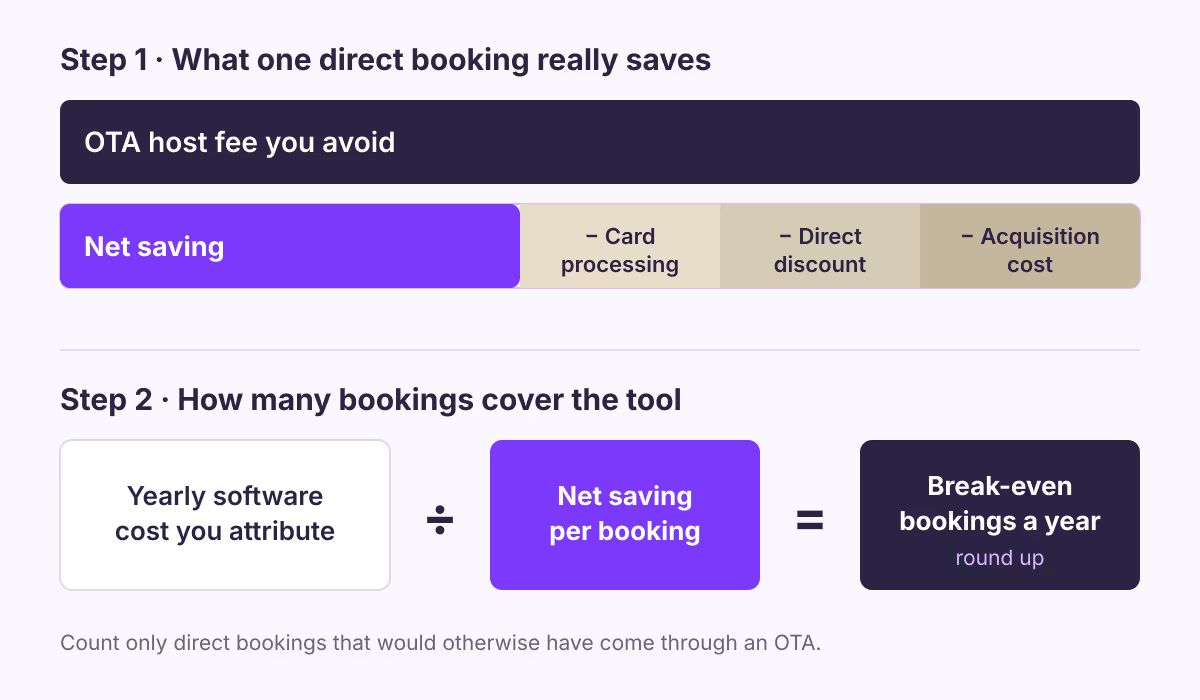
Two rules keep the result honest. First, count only direct bookings that would otherwise have come through an OTA. A guest who would have booked with you directly anyway didn't save you a commission. Second, use the fee amount your OTA actually deducts, not the headline rate, because each platform calculates its fee on a different base.
What OTA fee do you actually avoid on a direct booking?
You avoid only the host-side fee: the amount the OTA deducts from your payout or invoices you. A service fee the guest paid on top was never your money, so it doesn't belong in your saving.
Check your own statements, because the base differs by platform:
- Airbnb, single fee. Airbnb's service fee article says most hosts pay 15.5%, remaining hosts typically 14–16%, deducted from the payout. It's a percentage of the nightly price plus any fees you charge, excluding taxes.
- Airbnb, split fee. On the older split fee, the same article says most hosts pay 3% and guests pay a separate service fee of 14.1% to 16.5% of the booking subtotal. Airbnb says the split fee is being phased out, without giving a date.
- Booking.com. Its commission article describes a set percentage of the total booking amount, including fees such as cleaning. The rate depends on your country, property type and agreement; Preferred Partner and Visibility Booster add to it. City tax isn't commissioned, but in most countries VAT or GST is.
The split fee is where many calculations go wrong. If your Airbnb payout shows a 3% host fee, a direct booking avoids 3%, not 15%. The guest's 14–16% fee only becomes yours if you choose to price direct stays above your Airbnb nightly price, and that's a pricing decision with its own trade-offs, not a saving you can bank. To see both models on your own rate, run it through the Airbnb fee calculator, or read host-only vs split fee for how the two differ.
What does a direct booking cost you that the OTA used to cover?
Card processing always, and often a discount and some marketing spend. Each comes straight off the fee you avoided, so leave none of them out, even when they look small.
Card processing. You pay your payment provider on the direct price. Stripe's Ireland pricing page lists 1.5% + €0.25 for standard EEA cards, 2.8% + €0.25 for premium EEA cards, 2.5% + €0.25 for UK cards and 3.15% + €0.25 for international cards, plus 2% if currency conversion is needed. Stripe's prices differ by country, so use the page for yours.
Direct discount. If your own website knocks 5% off for booking direct, that 5% is a cost of the booking; count it. Keep the offer on your own channels: Airbnb's off-platform policy prohibits offering discounts to book off Airbnb.
Acquisition cost. Paid ads, a listing site fee or a referral reward, divided by the direct bookings they produced. For repeat guests and word of mouth this may be close to zero.
Other costs are real but harder to put on one booking: handling disputes and damage yourself, checking guests, and answering questions an OTA's checkout used to answer. If they take you meaningful time, add an amount per booking rather than pretending they're free.
How many direct bookings break even? Three hypothetical hosts
The answer swings from a handful a year to dozens, depending mostly on which OTA fee you avoid. The three examples below are invented to show the mechanism; replace every number with your own.
All three use BookBed's published monthly prices as the software cost: Starter at €12/month billed monthly or €9/month billed annually for up to 3 units, and Pro at €39/month billed monthly or €29/month billed annually for up to 25 units, per BookBed's pricing. BookBed charges a flat plan price, not a per-booking commission.
| Assumption | 1 unit | 3 units | 10 units |
|---|---|---|---|
| Plan and yearly cost | Starter monthly, €144 | Starter annual, €108 | Pro monthly, €468 |
| Booking value | €400 | €600 | €700 |
| OTA fee avoided | Airbnb split 3%: €12 | Airbnb single 15.5%: €93 | Booking.com 15% example: €105 |
| Card processing | Standard EEA: €6.25 | Standard EEA on €570: €8.80 | Premium EEA: €19.85 |
| Direct discount | none | 5%: €30 | none |
| Acquisition cost | €0 | €15 | €40 |
| Net saving per booking | €5.75 | €39.20 | €45.15 |
| Break-even per year | 26 bookings | 3 bookings | 11 bookings |
Read the rows as calculations, not predictions:
- The 1-unit host on the split fee needs 26 displaced bookings a year, because a direct booking avoids only €12 of Airbnb fees. Commission savings alone don't pay for the tool here.
- The 3-unit host on the single fee breaks even with three, even after a 5% discount and some marketing spend.
- The 10-unit host needs 11 a year, about one per unit, despite €40 of advertising per booking. The example Booking.com rate is applied to the booking value only; if commission also applies to VAT where you are, your avoided fee is higher.
If the net saving comes out at zero or below, there's no break-even: each direct booking costs you more than the OTA did, usually because the discount or ad spend is too high.
Should you count the whole subscription against direct bookings?
Only if direct bookings are the only reason you'd pay for the tool. If you'd use it anyway to keep calendars in one place, count only the part of its cost you wouldn't otherwise pay.
Run the calculation twice:
- Full-cost test. Put the whole yearly subscription in the formula. If direct bookings clear it, the tool pays for itself on commission alone.
- Incremental test. Put in only the extra cost the direct-booking part adds. If you'd already pay for calendar management, that's whatever you pay above the tool you'd use anyway, possibly nothing.
The first test protects you from over-crediting direct bookings with value that really comes from calendar work. The second stops you from rejecting a tool by charging its whole price to one feature. Which one applies is your call; write it down next to the result. If you're still deciding what calendar management is worth on its own, how to choose a channel manager covers that side.
Copy this break-even worksheet
Paste the labels into column A of a spreadsheet and your own numbers into column B, then add the two formulas.
| Row | Label in column A | Value in column B |
|---|---|---|
| 1 | Booking value, excl. taxes | your typical stay |
| 2 | OTA host fee rate | from your payout or invoice |
| 3 | Direct discount rate | 0 if none |
| 4 | Card fee percentage | from your provider |
| 5 | Card fee fixed amount | from your provider |
| 6 | Acquisition cost per booking | ads ÷ direct bookings |
| 7 | Yearly software cost attributed | full or incremental |
In B8, the net saving per booking:
=B1*B2-(B1*(1-B3)*B4+B5)-B1*B3-B6
In B9, the break-even bookings per year:
=IF(B8<=0,"No break-even",ROUNDUP(B7/B8,0))
Then compare B9 with how many bookings a year you could realistically take through your own channels, such as your website, referrals and past guests you can contact without going through an OTA. If B9 is far above that, commission savings won't carry the tool. The direct booking vs OTA comparison covers when direct booking is worth the effort.
When this calculation does not apply
- Your direct booking fills a night that would have stayed empty. Then the saving isn't the avoided fee; it's the whole booking. Don't mix those bookings into this calculation.
- You're on Airbnb's split fee and planning to stay on it. Your avoided fee is small, so judge the tool on calendar value, not commission.
- Guests you met on Airbnb. Airbnb's Off-Platform and Fee Transparency Policy prohibits off-platform links in listings or messages, encouraging users to move current, future or repeat bookings off Airbnb, and offering discounts to book off Airbnb. Count only guests who reach you independently.
- Your Booking.com contract or programs change. The rate is locked when a guest books, so recheck the formula when your agreement changes.
What to do next
- Pull your last Airbnb payout and Booking.com invoice and note the actual host fee on one stay.
- Look up your card processor's rate for the cards your guests mostly use.
- Fill in the worksheet with the full software cost, then again with the incremental cost.
- Estimate how many guests reach you through your own channels and compare with the break-even.
- Compare all your channels side by side in the OTA fee comparison.
About BookBed: BookBed charges a flat plan price and takes 0% commission on reservations made through its direct booking widget, which pays into your own Stripe account; Stripe's processing fees still apply. Compare OTA fees to fill in your avoided fee first.
Sources
- Airbnb Help Center, "Airbnb service fees" — Verified 2026-10-09
- Booking.com Partner Hub, "Understanding our commission" — Verified 2026-10-09
- Stripe, "Pricing" (Ireland) — Verified 2026-10-09
- Airbnb Help Center, "Off-Platform and Fee Transparency Policy" — Verified 2026-10-09
- BookBed, public pricing (pricing.md and /pricing) — Verified 2026-10-09