A rental that books every weekend in winter still spends most weeknights empty. Nobody is running taps, nobody notices a cold bathroom, and the first person to find a frozen pipe is often the guest who arrives with luggage on Friday afternoon.
You don't need a full seasonal shutdown for that gap. You need three decisions made before the last guest leaves: what stays running, whether the water stays on, and who goes inside before the next arrival. The table below sets those by gap length and forecast, and the check after it tells you what to look at once you're there.
What should stay on when a rental is empty in freezing weather?
Keep the heat on at a set floor, keep warm air reaching the pipes, and remove anything outside that can freeze and push pressure back into the house.
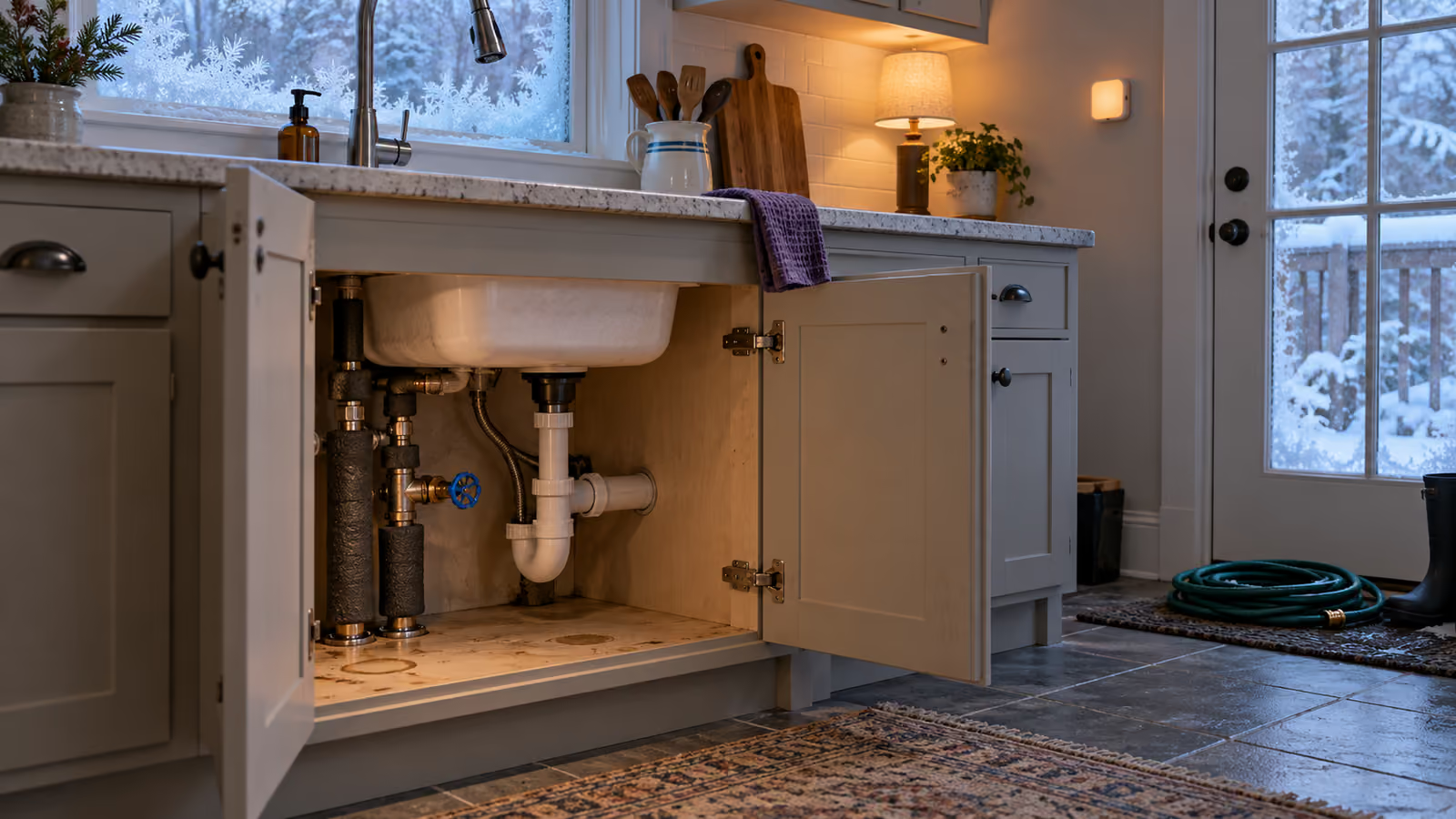
Indiana's Office of Utility Consumer Counselor advises that if you turn the thermostat down while away, you should not set it lower than 55°F (about 13°C), and that someone should check the home regularly, especially on very cold days. The same page recommends unhooking hoses from outdoor faucets, insulating exposed pipes in basements, crawl spaces and attics, and opening cabinet doors so room heat reaches pipes under sinks.
For a rental, that turns into a short checkout reset:
- Thermostat: set to your vacant floor, not off. If guests can change it, the reset belongs on the cleaner's or your own checkout list, not on the guest's.
- Cabinets: open the doors under kitchen and bathroom sinks, especially on outside walls.
- Outside: hoses disconnected and stored; garage doors closed if water lines run through the garage.
- Interior doors: left open so rooms at the far end of the house don't sit colder than the thermostat reading.
Heating costs money while nobody is paying for the night. That cost is real, but it is the trade insurers generally expect you to make, as the next section explains.
Should you shut off the water between bookings?
Closing the main makes sense when nobody will be inside before the next guest or the gap runs long; leaving it on works when someone checks the unit and the heat is reliable.
Insurers look at this directly. The National Association of Insurance Commissioners says policies generally expect you to maintain the home at a minimum temperature, or shut off the water supply if the home is vacant, and that a burst-pipe claim may not be covered if the insurer finds you skipped those steps. The Maryland Insurance Administration gives the same guidance. Your own policy wording decides what "vacant" means and for how long, so read it or ask your insurer. Our vacation rental insurance guide lists the questions to ask.
Closing the main valve limits how much water a split pipe can release, but it doesn't stop the pipe from freezing. Heat still matters. Before you make a habit of closing the main, ask a plumber or heating technician whether anything in the house depends on the supply, such as a boiler that tops itself up, a fire sprinkler line or an irrigation backflow device.
Decision table: what to leave running for this gap
These rows are recommendations built from the sources above, not rules from any authority. Adjust them to your insurer's wording and your house.
| Gap and forecast | Heat | Water | Inside check before arrival |
|---|---|---|---|
| Lows stay above freezing | Normal vacant setting | On | Standard turnover |
| Lows below freezing, someone checks | 55°F floor or higher | On, cabinets open | Day before arrival |
| Lows below freezing, nobody can check | 55°F floor or higher | Main closed | Required before guest entry |
| Forecast at or below 0°F | 55°F floor or higher | See note below | Same day as arrival |
| Gap of several weeks | Per policy | Main closed; ask about draining | Before reopening |
For the 0°F row, Indiana's guidance switches to keeping water moving: run at least one faucet as a small, pencil-size stream, preferably on an exterior wall. You can only do that with the water on, so it suits a house someone is watching. If nobody can watch it, closing the main and keeping the heat on is the safer pairing. Leave portable space heaters off in an empty house. Draining a whole system for a long closure is a plumber's job, because a partly drained line can still hold water at the low points.
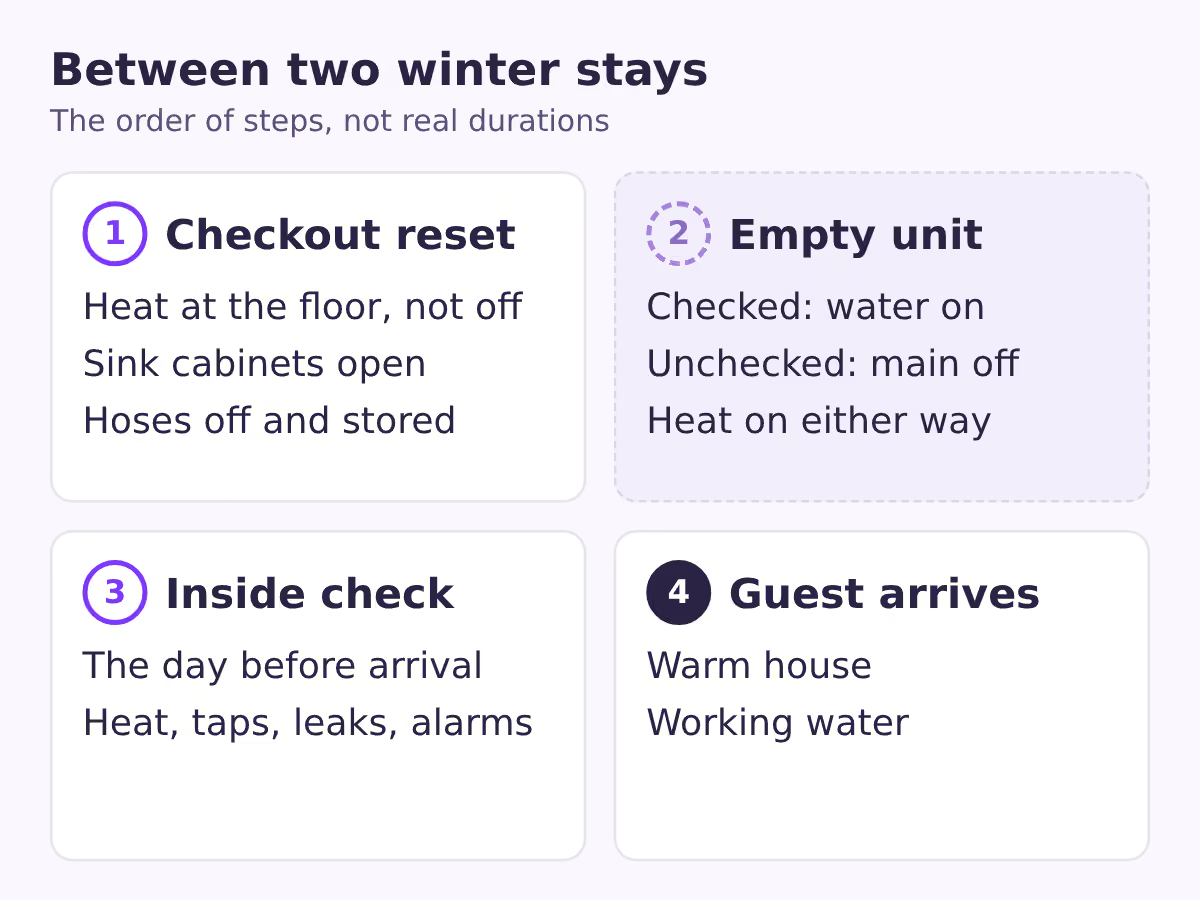
The diagram shows the order of the decisions, not how long each stretch lasts in your calendar. A two-night gap and a three-week gap both need the same three points: a reset at checkout, a water decision, and a check before the next guest.
What should the pre-arrival check cover?
Someone stands inside the unit, confirms the heat and water work everywhere, tests the alarms, and has time left to fix a problem before the guest gets the door code.
The timing is the point. A check two hours before arrival finds the problem; a check the day before still leaves time to call a plumber or contact the guest. Walk the house in this order:
- Temperature in the far rooms. Read the thermostat, then stand in the coldest bathroom or the room above the garage. A big difference means heat isn't reaching that part of the house.
- Water back on, slowly. If the main was closed, follow the same approach Indiana gives for turning water back on after a thawed pipe: open it slowly and watch for leaks, ready to close it again.
- Every tap and toilet. Run hot and cold at each fixture. In freezing weather, a tap that gives only a trickle or nothing at all may have a frozen line feeding it.
- Under sinks, around the water heater, ceilings below bathrooms. Look for water, stains or warped boards.
- Smoke and CO alarms. Ready.gov advises working carbon monoxide detectors on every level and testing battery-backed smoke and CO alarms. Airbnb also urges hosts to test alarms regularly and keep the listing's safety devices accurate.
- Outside. Steps, path and parking clear enough to reach the door, and the lockbox or keypad working if the guest uses self check-in.
- Reset for the guest. Thermostat back to a comfortable setting so the house is warm when they arrive.
If the check finds a frozen pipe
Indiana's guidance is direct: close the master shut-off valve, call a licensed plumber, and never use a torch or any open flame to thaw a pipe. Ready.gov also warns never to heat a home with a gas stovetop or oven.
Then contact the arriving guest as early as you can with what happened and what you can offer. Your options for moving or cancelling depend on the platform the guest booked through and its policies, so check those before you promise anything. Our guest communication guide covers how to write that message.
What to tell guests about the heat
Guests in winter often turn the heat down or off when they leave, because that's what they do at home. Put the rule in your checkout message: "Please leave the thermostat at 60°F or higher when you check out." Choose a number at or above your vacant floor, and say why in one short sentence so it doesn't read as a fussy house rule. Add the same line to the printed house guide by the thermostat.
If the property has a programmable or connected thermostat, you can set the vacant floor yourself after checkout instead of relying on the guest. Check the manufacturer's documentation for the lowest setpoint and lockout options it supports.
How do you know which units are empty and for how long?
Start from the calendar: list each unit's next checkout and next arrival, because the gap length and the forecast together decide which table row you're in.
With one unit you can read that off one channel. Across several units on Airbnb, Booking.com and direct bookings, gaps hide between calendars. A week of short gaps across five units means five checkout resets and five pre-arrival checks, which is a schedule for whoever does them, not just a reminder. Our operations guide shows how to turn each booking into a task list.
Calendar data has a lag. Airbnb says it updates connected calendars every 3 hours, and other platforms import on their own schedules. A gap you planned as empty can pick up a booking you haven't seen yet, so check the booking channels again on the morning of a planned shutoff.
About BookBed: On Pro, BookBed's multi-channel timeline shows every unit's bookings in one view, including Airbnb and Booking.com stays imported through two-way iCal, so you can see which units sit empty and when each next guest arrives. iCal imports aren't instant, and BookBed doesn't monitor temperatures, control thermostats or send anyone to check the property; the inspection stays with you or your team. See BookBed pricing
When this advice does not apply
- Warm climates. If overnight lows rarely reach freezing, the standard turnover is enough most of the year. Watch for the occasional hard freeze.
- Apartments and condos. Shared plumbing, building heat and association rules may decide who can close a valve or change the heat. Ask the building manager first.
- Seasonal closures. Shutting a cabin for the winter is a different job: a plumber drains the system, and your insurer may have specific vacancy terms.
- Your policy wins. If your insurer's wording sets a different temperature or a vacancy period, follow the policy, not this table.
What to do next
- Find the main shut-off valve in each unit and label it, so whoever checks the house can find it fast.
- Read your property policy's vacancy and freeze wording, and ask your insurer what applies to empty nights between stays.
- Add the checkout reset (thermostat floor, cabinets open, hoses off) to your cleaner's turnover list.
- Pick who does the pre-arrival check for each unit, and when.
- Put the thermostat line in your checkout message and house guide.
Sources
- Indiana Office of Utility Consumer Counselor, "Preventing frozen pipes". Verified 2026-10-28
- National Association of Insurance Commissioners, "Will my homeowners insurance policy cover water damage from a burst pipe?". Verified 2026-10-28
- Maryland Insurance Administration, "Protect your pipes". Verified 2026-10-28
- Ready.gov, "Winter Weather". Verified 2026-10-28
- Airbnb Help Center, articles 514 (safety devices) and 99 (calendar sync). Verified 2026-10-28