You look at your bank account at the end of the season and the number doesn't match the booking totals you remember. That gap is normal. Vacation rental revenue passes through several stages before it reaches you, and each stage has its own leaks: nights that never sold, rates set too low, platform fees, and costs you pay after the payout lands.
Start with one action today: export the last 12 months of reservations from every platform you use, and put them in one sheet with four columns per booking: nights, total the guest paid, what the platform kept, and what landed in your bank. Every question in this guide, from projections to pricing, gets easier once that sheet exists.
This page is the hub. It explains how to read and project your revenue, then points you to the guide that goes deep on each lever.
What counts as vacation rental revenue?
Vacation rental revenue has three layers: gross booking value (what guests pay), payout (what the platform sends after its fees), and net income (what's left after your own operating costs). Mixing them up is the most common reason projections go wrong.
Here's how the layers stack:
| Layer | What it includes | Where you find it |
|---|---|---|
| Gross booking value | Nightly rate plus host fees such as cleaning, before platform fees | Reservation details on each platform |
| Payout | Gross minus the platform's service fee or commission | Payout reports and bank statements |
| Net income | Payout minus cleaning, laundry, utilities, supplies, software, tax | Your own books |
The platform fee between gross and payout isn't the same everywhere. Airbnb's service fee article says it's moving all home hosts to a single fee deducted from the payout, where most hosts pay 15.5%, applied to the nightly price plus host fees such as cleaning. Booking.com's commission article describes a set percentage of the total booking amount, including cleaning and other fees, that depends on your country, property type and agreement, with extra percentage added if you join programs like Preferred Partner or Visibility Booster. It isn't charged on city tax.
Direct bookings have a smaller gap but not zero. If you take card payments through Stripe, its Ireland pricing page lists 1.5% + €0.25 for standard EEA cards.
Timing matters too. Booking.com says on its Payments by Booking.com page that payouts can be monthly, weekly or in some countries daily, and its commission article says commission is invoiced monthly, after checkout. That's why your bank balance in a given month rarely equals the bookings you took that month.
How do you build vacation rental revenue projections for a year?
Build vacation rental revenue projections month by month: available nights times expected occupancy gives booked nights, booked nights times expected nightly rate gives gross, and subtracting each channel's fee share gives payout.
Write it as one line per month or season:
Projected payout = available nights × occupancy × average nightly rate × (1 − blended channel fee)
Consider a hypothetical one-bedroom apartment with a strong summer and a quiet winter. Every input below is an assumption for illustration, not a benchmark:
| Season | Available nights | Assumed occupancy | Booked nights | Assumed nightly rate | Gross |
|---|---|---|---|---|---|
| Peak (Jun–Aug) | 92 | 85% | 78 | €140 | €10,920 |
| Shoulder (May, Sep, Oct) | 92 | 60% | 55 | €105 | €5,775 |
| Low (Nov–Apr) | 181 | 30% | 54 | €80 | €4,320 |
| Year | 365 | about 51% | 187 | about €112 | €21,015 |
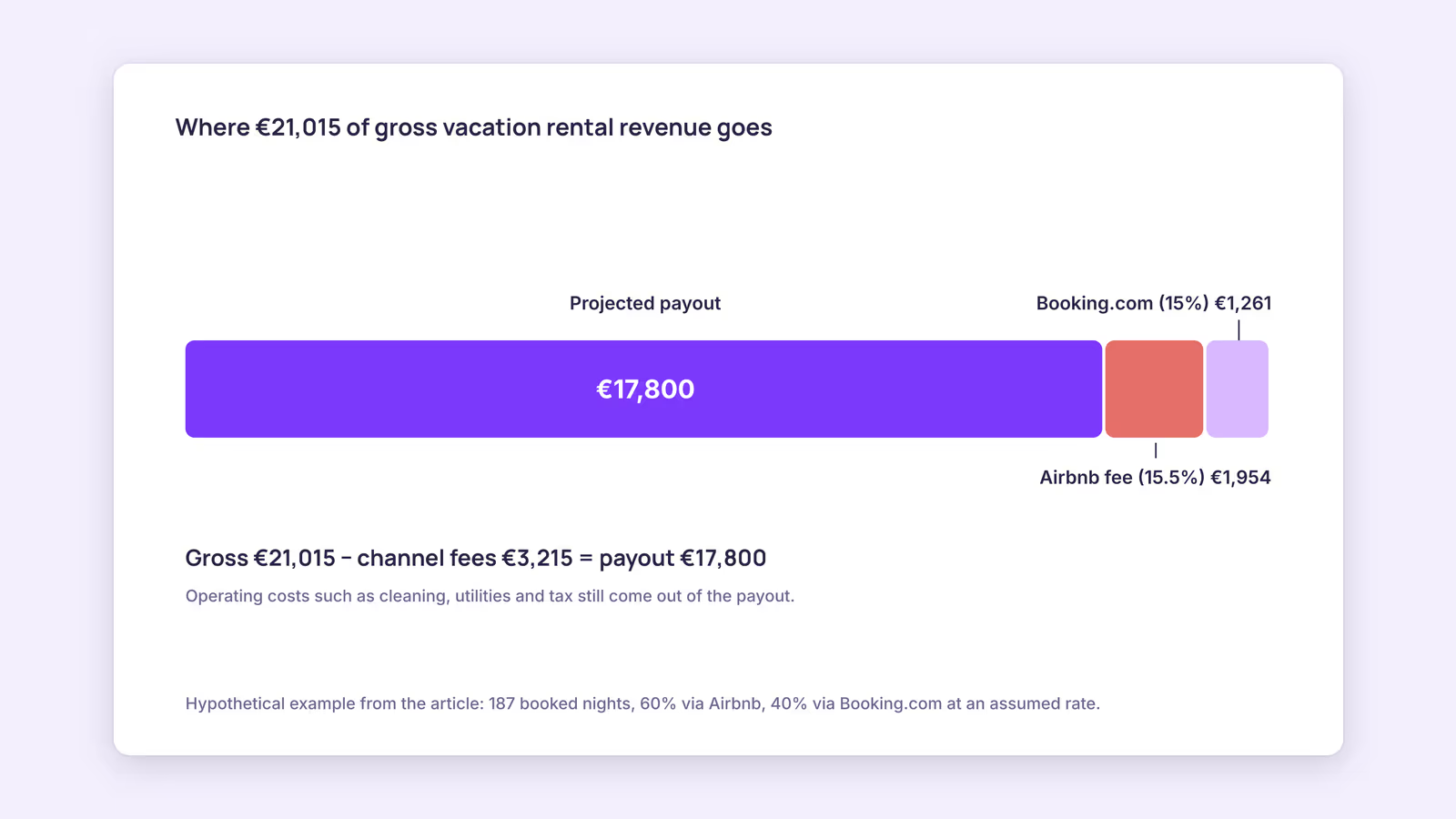
Now take off channel fees. Assume 60% of that gross comes through Airbnb on the single fee and 40% through Booking.com at an assumed 15% commission (check your own contract, because Booking.com rates vary):
- Airbnb: €12,609 × 15.5% = €1,954
- Booking.com: €8,406 × 15% = €1,261
- Projected payout: €21,015 − €3,215 = €17,800
That €17,800 still isn't income. Cleaning, laundry, utilities, supplies, software and tax come out next, and those depend entirely on your property. This worked example also leaves out cleaning fees you collect from guests. Add them to gross if you charge them, and remember both platforms take their cut of those too.
Two things this projection teaches you. First, the low season has the most unsold nights. In this example, 10 more points of winter occupancy is about 18 extra nights × €80 = €1,440 gross, while €10 more per peak night adds 78 × €10 = €780. That suggests filling quiet months can matter as much as squeezing summer, but it's an inference from made-up numbers; run it with yours. Second, the fee line is large enough that it deserves its own row every month, not a rough guess at year end.
A spreadsheet with these columns works as a free vacation rental income calculator. Update the assumptions with actual results each month and the projection turns into a forecast you can check.
Which vacation rental revenue problem should you fix first?
Fix the stage where the gap between your projection and your actuals is biggest: unsold nights point to occupancy, sold-out peaks point to rate, and a large fee share points to channel mix.
Use this table to diagnose, then go to the guide that covers that lever in depth:
| What your 12-month sheet shows | Weak stage | Where to go next |
|---|---|---|
| You can't tell which metric changed | Measurement | Short-term rental KPIs |
| Peak months sell out early, low months stay empty | Pricing over time | Revenue management basics |
| Gross looks fine, payout disappoints | Fees and rate per channel | Fees and pricing guide |
| Occupancy, rate and fees all look reasonable but income is flat | Choosing one lever to pull | How to maximize income from existing units |
Our recommendation: pick one row, change one thing, and compare the next month's actuals with your projection before touching anything else. Changing rates, minimum stays and channels in the same month makes it impossible to tell which change worked.
When this advice does not apply
- Long-term or mid-term leases: monthly rent under a tenancy agreement follows different rules, fees and tax treatment than nightly stays.
- Hotel-style inventory: properties with many identical rooms usually measure revenue per room type and use dedicated revenue systems.
- Tax and accounting questions: how revenue is taxed, and whether VAT applies to your stays, depends on your country. Ask a local accountant rather than using the projection above as a tax figure.
- Older Airbnb fee setups: if you're still on the split fee, your payout deduction is smaller and guests pay a separate service fee. Check your own payout report.
What to do next
- Export 12 months of reservations from every platform into one sheet with nights, guest total, platform fee and payout.
- Split the year into peak, shoulder and low seasons and fill in the projection table with your own numbers.
- Add a fee row per channel using the rates in your own payout reports and contracts.
- Compare projection against actuals each month and note which stage has the biggest gap.
- Open the guide for that stage from the diagnostic table and change one thing at a time.
FAQ
How do you calculate vacation rental income?
Add up what guests paid, subtract what each platform kept to get your payout, then subtract operating costs such as cleaning, supplies, utilities and software. Use actual payout reports rather than listed nightly rates, because discounts and fees change the result.
Are vacation rentals profitable?
It depends on your costs, not only your revenue. Two units with identical bookings can end the year very differently because of mortgage, cleaning costs, local taxes and how much of their revenue came through high-fee channels. Build the projection above, then subtract your real costs before judging.
Should you project revenue monthly or yearly?
Monthly. Seasonal swings, payout timing and monthly commission invoices make a yearly average misleading. A monthly sheet also shows you early when a season is falling behind.
About BookBed: BookBed's embeddable direct booking widget takes payments through Stripe checkout straight into your own Stripe account, with 0% commission from BookBed, so direct stays only carry Stripe's processing fee in your fee row. The widget doesn't bring traffic on its own; guests still need to find your site. Try BookBed free
Sources
- Airbnb Help Center, "Airbnb service fees" — Verified 2026-09-30
- Booking.com for Partners, "Understanding your commission" — Verified 2026-09-30
- Booking.com for Partners, "Payments by Booking.com" — Verified 2026-09-30
- Stripe, "Pricing" (Ireland) — Verified 2026-09-30
- BookBed, "Pricing" (public/pricing.md) and product docs (data/docs.en.json) — Verified 2026-09-30