
Five days out, two nights between bookings are still open. A discount might fill them, and an empty night earns nothing. But a booked night isn't free: someone has to clean the place, the platform takes its fee, and a discount set too wide can also cut the price of nights that would have sold anyway.
You can settle this with two numbers. The first is your floor, the lowest nightly price at which a stay still covers what it costs you to host it. The second is how much more likely the discount has to make a booking before it earns more than holding your price. Have your cleaning cost and your Airbnb fee rate ready, and you can work both out in a few minutes.
When is a last-minute discount worth it?
A last-minute discount is worth it when the discounted stay still pays more than it costs to host, and when the discount makes a booking likely enough to beat waiting at your normal price.
The first test is arithmetic. The second needs your judgment, because nobody can tell you for certain whether a given night would have booked without the discount. You can still make that judgment specific, and the sections below show how. A third check covers the nights around the gap, since a discount rule rarely touches only the one date you're looking at.
What does a booked night actually cost you?
It costs the turnover for the stay plus whatever each occupied night uses, and on Airbnb the platform fee also comes out of your nightly price and your cleaning fee.
List the costs that only exist because a guest stays:
- Turnover: cleaner pay, laundry and restocked supplies. You pay this once per stay, whether the stay is one night or five.
- Per occupied night: extra electricity, water, heating or cooling, and consumables such as coffee and toiletries.
- Platform fee: Airbnb says most hosts on its single-fee structure pay 15.5%, with remaining hosts typically between 14% and 16%. Hosts still on the split fee usually pay 3%. Airbnb calculates the fee on the nightly price and the fees you charge, excluding the guest service fee and taxes.
Leave out mortgage, insurance and software. You pay those whether the night books or not, so they don't change this decision.
The floor follows from those inputs:
Floor per night = ((turnover + nightly costs × nights) ÷ (1 − fee rate) − cleaning fee) ÷ nights
Any nightly price above the floor leaves you better off than an empty night, in pure cash terms.
A worked example: two nights versus one
This example is hypothetical. Replace every input with your own:
- Normal price: $180 per night
- Guest-paid cleaning fee: $95 per stay
- Your turnover cost: $110
- Your costs per occupied night: $18
- Airbnb fee: 15.5%
| Gap | Discount | Nightly price | Your payout | Left after costs |
|---|---|---|---|---|
| 2 nights | none | $180 | $384 | $238 |
| 2 nights | 20% | $144 | $324 | $178 |
| 2 nights | 35% | $117 | $278 | $132 |
| 1 night | none | $180 | $232 | $104 |
| 1 night | 20% | $144 | $202 | $74 |
| 1 night | 35% | $117 | $179 | $51 |
Payout is (nights × nightly price + cleaning fee) × 0.845. "Left after costs" subtracts the turnover and the nightly costs. Figures are rounded to the nearest dollar.
With these inputs the two-night floor is about $39 a night and the one-night floor is about $56. Both are low because the $95 cleaning fee covers most of the $110 turnover.
The picture changes if you charge less for cleaning on short stays. Airbnb lets hosts set a lower short-stay cleaning fee for one- and two-night bookings. At a $50 short-stay fee, the one-night floor in this example rises to about $101, and a 35% discount leaves about $13 after costs. A lower cleaning fee may make a short stay more attractive to guests, but it moves more of the turnover onto the nightly price.
Clearing the floor only shows that the stay pays for itself. It doesn't show that the discount was needed.
How much more likely does a discount have to make a booking?
Divide what the stay leaves you at full price by what it leaves you at the discounted price. The answer is how many times more likely the discount must make a booking before it comes out ahead.
In the two-night example, $238 ÷ $178 is about 1.3. If you think a 20% discount makes the gap roughly 1.3 times as likely to book as your normal price, the two choices come out about even. If you think it doubles the odds, the discount is the better bet. At 35% off, the ratio rises to about 1.8.
For the one-night gap the ratio is about 1.4 at 20% off and about 2 at 35% off. With the $50 short-stay fee it becomes about 1.8 and 5. A night that barely clears its floor needs a very large jump in booking odds to justify the cut.
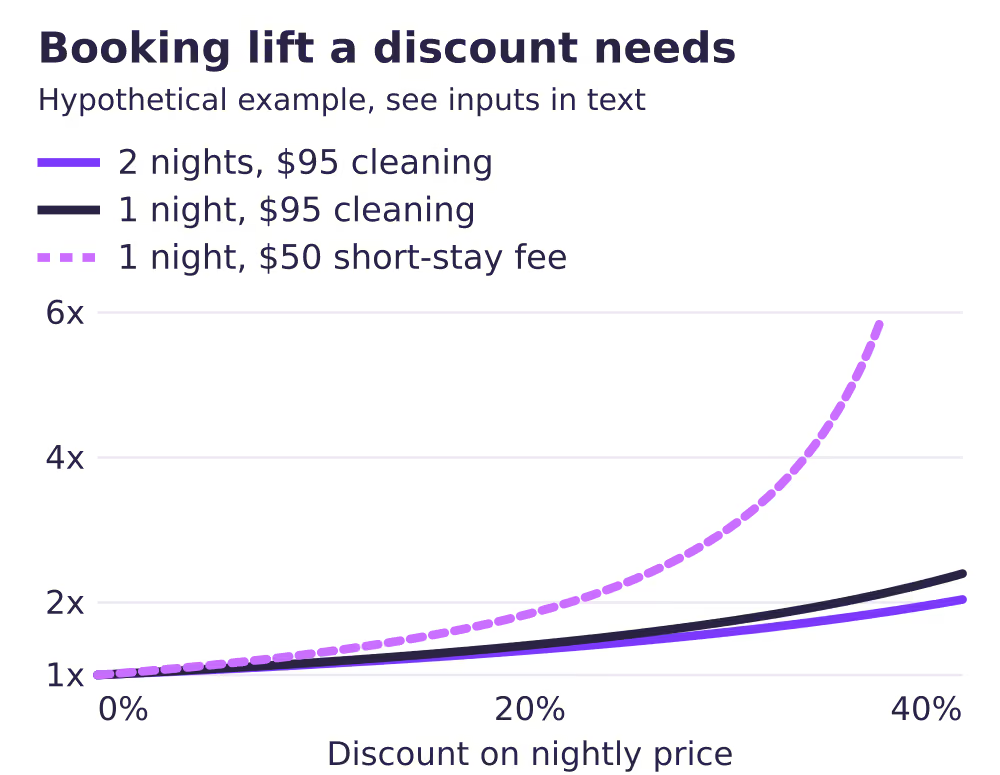
The chart plots the same hypothetical inputs across every discount from 0% to 40%. It shows how quickly the required lift climbs. It can't tell you what lift your listing will actually get. That part is your estimate.
To estimate it, look at your own history for comparable dates. Did nights like this, at this distance from check-in, usually book anyway, sometimes book, or almost never book? Your past calendars and reservation records are the evidence here. If similar nights often filled in the final week at full price, the discount has to work hard to beat that. If they almost never did, even a modest discount faces a low bar.
How do you avoid underpricing the nights around the gap?
Keep the discount to the dates you actually want to fill. A rule that covers every open night inside a window will also discount nights that are still selling normally.
On Airbnb, the last-minute discount applies to reservations confirmed 1 to 28 days before check-in, and you choose the number of days. Airbnb says the discount isn't available while Smart Pricing is on. Three checks keep it from spreading further than you meant:
| Check | What can go wrong | What to do instead |
|---|---|---|
| Window length | A 28-day window discounts dates that are still weeks from their usual booking time | Set the window to roughly when similar nights stop booking at full price in your history |
| Strong dates in the window | A Saturday or event night gets the same cut as a quiet Tuesday | Price that one gap date in the calendar instead of using a blanket rule |
| Other discounts | Airbnb says only one of its length-of-stay, last-minute, early-bird or promotion discounts applies per reservation; a top-rated guest discount can still combine with it | Check the guest's total for a stay that qualifies for both your weekly and last-minute discounts |
Visibility is a separate question. Airbnb says guests see a crossed-out markdown in search when you offer 10% or more off your 60-day median price. A 5% cut may fill a night on price alone, but it won't trigger that label. Airbnb also requires a minimum daily price of $10 after discounts, which only matters at extreme cuts.
There's one more nearby-night risk. Guests who see the same low price week after week may learn to book late. We have no data showing how often that happens, but it's a reason to reserve deep discounts for genuinely stranded nights rather than make them a weekly habit.
Fill the gap without cutting the price
A short gap sometimes stays empty because of a stay rule, not because of the price. If your minimum stay is three nights, a two-night gap can't be booked at any discount. Lowering the minimum for those dates may fill them at full price. Our guide to Airbnb minimum stay strategy covers setting trip lengths for specific dates.
Airbnb announced on September 30, 2026 that suggestions to adjust last-minute settings start rolling out in October, including automatic minimum-stay changes to unblock nights between bookings. Rollouts reach accounts at different times, so check your own calendar before planning around it. Treat any suggestion as an input to the math above, not a replacement for it.
When this advice does not apply
- Fixed cleaning costs. If you clean the unit yourself or pay a cleaner a fixed monthly amount, your real turnover cost per stay is lower than an invoice suggests. Use what one extra stay actually adds.
- Smart Pricing or a dynamic pricing tool. Airbnb's last-minute discount isn't available with Smart Pricing on, and third-party tools may already discount near dates. Check what the tool does before stacking your own rule on top.
- Local stay rules. Some US cities and EU regions may set minimum stay lengths or night caps for short-term rentals. Those rules override any pricing decision here.
- Other channels. Booking.com and other OTAs have their own promotion types and fee terms. The formula works anywhere, but use that channel's fee rate and confirm its promotion rules in its extranet.
What to do next
- Write down your real turnover cost and your costs per occupied night.
- Confirm which Airbnb fee structure and rate apply to your listing, then run the floor formula for a one-night and a two-night gap. The Airbnb fee calculator can check the payout step.
- Divide full-price leftover by discounted leftover for the discount you're considering. Ask whether your history supports that much of a lift.
- Set your last-minute window from your own booking history, and price strong dates individually.
- Before you discount a short gap, check whether your minimum stay is what's keeping it empty. For the wider pricing picture, see our vacation rental pricing strategy and how discounts move your average daily rate.
About BookBed: On Pro, BookBed's multi-channel timeline shows every unit's bookings in one view, including Airbnb and Booking.com stays imported through two-way iCal, so you can see one- and two-night gaps next to the bookings around them. Each platform imports calendars on its own schedule, so a very recent booking may not appear yet. BookBed doesn't set your Airbnb prices, forecast demand or apply discounts for you; the floor and the decision stay yours. See BookBed pricing
Sources
- Airbnb Resource Center, "5 ways to get last-minute bookings". Verified 2026-10-27
- Airbnb Help Center, "How discounts are applied" (article 3421). Verified 2026-10-27
- Airbnb Help Center, "Airbnb service fees" (article 1857). Verified 2026-10-27
- Airbnb Help Center, "Add cleaning fees to home listings" (article 58) and "Weekly and monthly discounts for home stays" (article 1233). Verified 2026-10-27
- Airbnb Resource Center, "New tools to host smarter, not harder" (September 30, 2026). Verified 2026-10-27
- BookBed, public pricing.md and documentation (timeline calendar, two-way iCal, per-unit pricing). Verified 2026-10-27