You're looking at a property listing, or at a spreadsheet a seller or agent handed you, and it says the place runs at an 8% cap rate. Before you compare that figure with anything, rebuild it yourself. A cap rate vacation rental estimate is only as good as its income and expense lines, and short-term rental projections are easy to inflate.
Your first action: ask for, or build, a line-by-line operating budget for a full year, and check whether platform fees, cleaning, furnishing replacement and management time are in it.
How do you work out a cap rate vacation rental investors can trust?
Cap rate is net operating income for one year divided by the property's price or current value, which estimates your return as if you'd bought the property outright with no mortgage.
The formula:
Cap rate = Net operating income (NOI) ÷ Property value or purchase price
NOI is gross revenue minus operating expenses. Mortgage payments are left out on purpose, so you can compare a financed deal with a cash deal on the same footing. Income tax and depreciation are also left out.
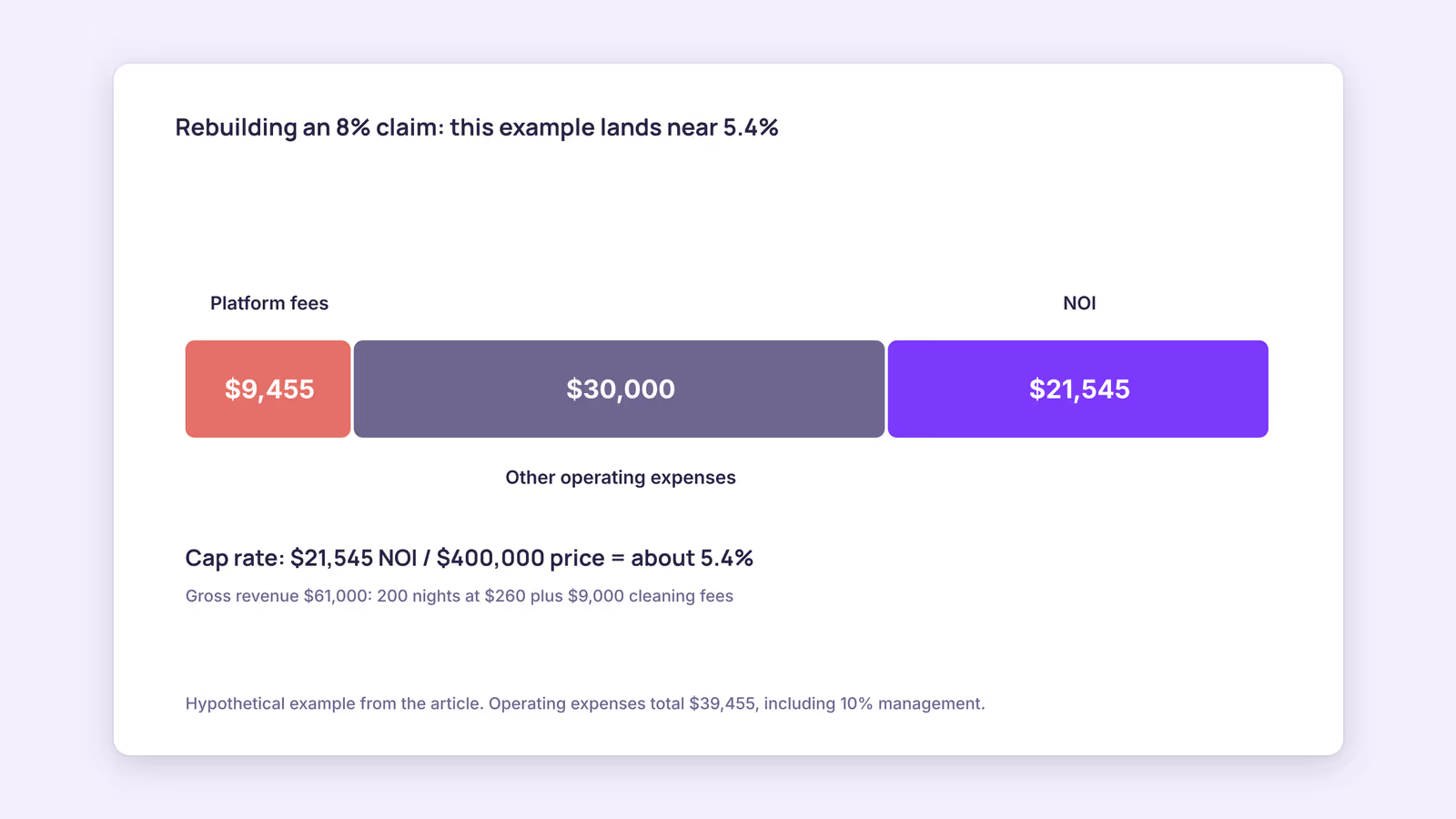
Here's a worked example. Consider a hypothetical $400,000 two-bedroom unit. These inputs are illustrative, not market data:
| Line | Amount | Note |
|---|---|---|
| Nightly revenue | $52,000 | 200 booked nights at $260 average |
| Cleaning fees collected | $9,000 | 60 stays at $150 |
| Gross revenue | $61,000 | |
| Platform fees | $9,455 | 15.5% host-only fee on nightly price plus cleaning fee |
| Cleaning cost | $7,200 | 60 turnovers at $120 |
| Utilities, internet, streaming | $4,800 | |
| Property tax and insurance | $6,500 | |
| Repairs and furnishing replacement | $3,600 | |
| Supplies and software | $1,800 | |
| Management (own time or a manager) | $6,100 | 10% of gross |
| Operating expenses | $39,455 | |
| NOI | $21,545 |
$21,545 ÷ $400,000 = about 5.4%.
Notice the platform line. On Airbnb's single-fee structure, the host fee is most commonly 15.5% and is charged on the nightly price plus host fees such as cleaning, according to Airbnb's service fee page. Booking.com takes a commission on the total booking amount, including fees like cleaning, at a percentage that depends on country, property type and agreement, per its commission explainer. If your projection only uses the nightly rate, or skips fees altogether, the cap rate is overstated. You can model your own fee line with the Airbnb fee calculator or compare channels in the OTA fee comparison.
Also notice the management line. If you plan to run the property yourself, your time still has a cost. Leave it out and you're comparing a job plus an investment against a passive one.
What is a good cap rate for Airbnb and other short-term rentals?
There's no universal good cap rate for Airbnb properties; a reasonable target depends on your local market, financing costs, regulatory risk and how much work you're taking on, so compare against your own alternatives.
We didn't find a primary source that publishes a reliable average Airbnb cap rate you can apply everywhere, so this post doesn't quote one. Figures you see online usually come from projected revenue, and they mix markets, property types and years.
Our recommendation is to judge a short-term rental cap rate against three benchmarks you can check yourself:
- The same property as a long-term rental. Price a standard lease locally and run the same formula. If the short-term figure isn't clearly higher, you're taking on hospitality work and platform risk for little extra.
- Your cost of borrowing. If the cap rate sits below your mortgage interest rate, borrowing tends to reduce your return on cash rather than increase it.
- A low-effort alternative. Compare with what your cash would earn with no management at all.
Should cap rate be high or low? Higher means more income per dollar of price, which you want as a buyer. But a high cap rate can also signal risk: a market with tightening short-term rental rules, a seasonal location, or revenue that depends on peak weeks. A high number deserves more scrutiny, not less.
Which inputs make short-term rental cap rates misleading?
The biggest distortions come from optimistic occupancy and nightly rates, missing platform fees, uncounted management time and ignored furnishing costs, and each one can move the result by whole percentage points.
Use this checklist on any projection, including your own:
| Check | Question to ask | If the answer is no |
|---|---|---|
| Revenue basis | Is revenue based on real booked nights, not a best-case calendar? | Cut occupancy to a conservative case and recalculate |
| Fees | Are platform fees applied to nightly price plus cleaning? | Add them at the rate your channels actually charge |
| Payment costs | Are card processing fees included for direct bookings? | Add them |
| Management | Is your time or a manager's fee counted? | Add a management line |
| Furnishing | Is replacement of linens, furniture and appliances budgeted? | Add an annual reserve |
| Regulation | Are permits, registration and local taxes accounted for? | Check local rules before trusting the number |
| Seasonality | Does one peak season carry most of the year? | Run a bad-season scenario |
For direct bookings you avoid OTA commission but still pay card processing. Stripe, for example, lists standard EEA cards at 1.5% + €0.25 on its Ireland pricing page. That's much smaller than a platform fee, which is why channel mix changes NOI. This suggests that two identical properties can show different cap rates purely because of where their bookings come from.
Then run a sensitivity test. In the example above, dropping to 170 booked nights and 51 stays lowers gross revenue by roughly $9,150. Expenses tied to bookings shrink a little, but fixed costs don't, and the cap rate falls well below 5%. If a deal only works at the optimistic case, it doesn't work.
Cap rate also ignores up-front furnishing and setup, because those are capital spending, not operating expenses. To see how furnishing, down payment and mortgage affect the return on your actual cash, use cash-on-cash return alongside cap rate. If you haven't bought yet, the guide to starting an Airbnb covers the setup costs to budget for.
When this advice does not apply
Cap rate is a rough screening tool. It fits less well if you'll use the property yourself for part of the year, since personal-use nights cut both revenue and the comparison with a pure investment. It's also weak for properties that need major renovation before renting, where the purchase price doesn't reflect your real cost. Tax treatment, depreciation and local short-term rental rules vary by country and city; talk to a local accountant or lawyer before relying on any after-tax figure.
What to do next
- Rebuild the seller's or your own projection line by line using the table format above.
- Apply your real channel fees to nightly price plus cleaning, not just the nightly rate.
- Run a conservative case with lower occupancy and rate, and see if the cap rate still beats a long-term lease.
- Calculate cash-on-cash return to include furnishing and financing.
- Check local permit and registration rules before you commit.
FAQ
How do I use an Airbnb cap rate calculator?
Any calculator needs the same three inputs: annual gross revenue, annual operating expenses excluding mortgage, and the price. Check that its expense list includes platform fees, cleaning and management, or add them yourself.
Is cap rate the same as ROI?
No. Cap rate ignores financing and setup costs. ROI and cash-on-cash return measure what you earn on the cash you actually put in, including down payment and furnishing.
Do I use purchase price or current value?
Use purchase price when you're evaluating a deal. For a property you already own, current market value tells you whether your equity would earn more elsewhere.
About BookBed: Commission is one of the operating expenses in your NOI. BookBed's embeddable direct booking widget takes payments into your own Stripe account with 0% BookBed commission, so direct bookings carry only Stripe's processing fee. The widget doesn't bring traffic on its own; you still need repeat guests or your own marketing. See BookBed pricing
Sources
- Airbnb Help Center, "Airbnb service fees" — Verified 2026-09-30
- Booking.com for Partners, "Understanding your commission" — Verified 2026-09-30
- Stripe, "Pricing & fees" (Ireland) — Verified 2026-09-30
- BookBed, "Pricing" (public/pricing.md) — Verified 2026-09-30